
Stephen Sefton, August 10th 2025
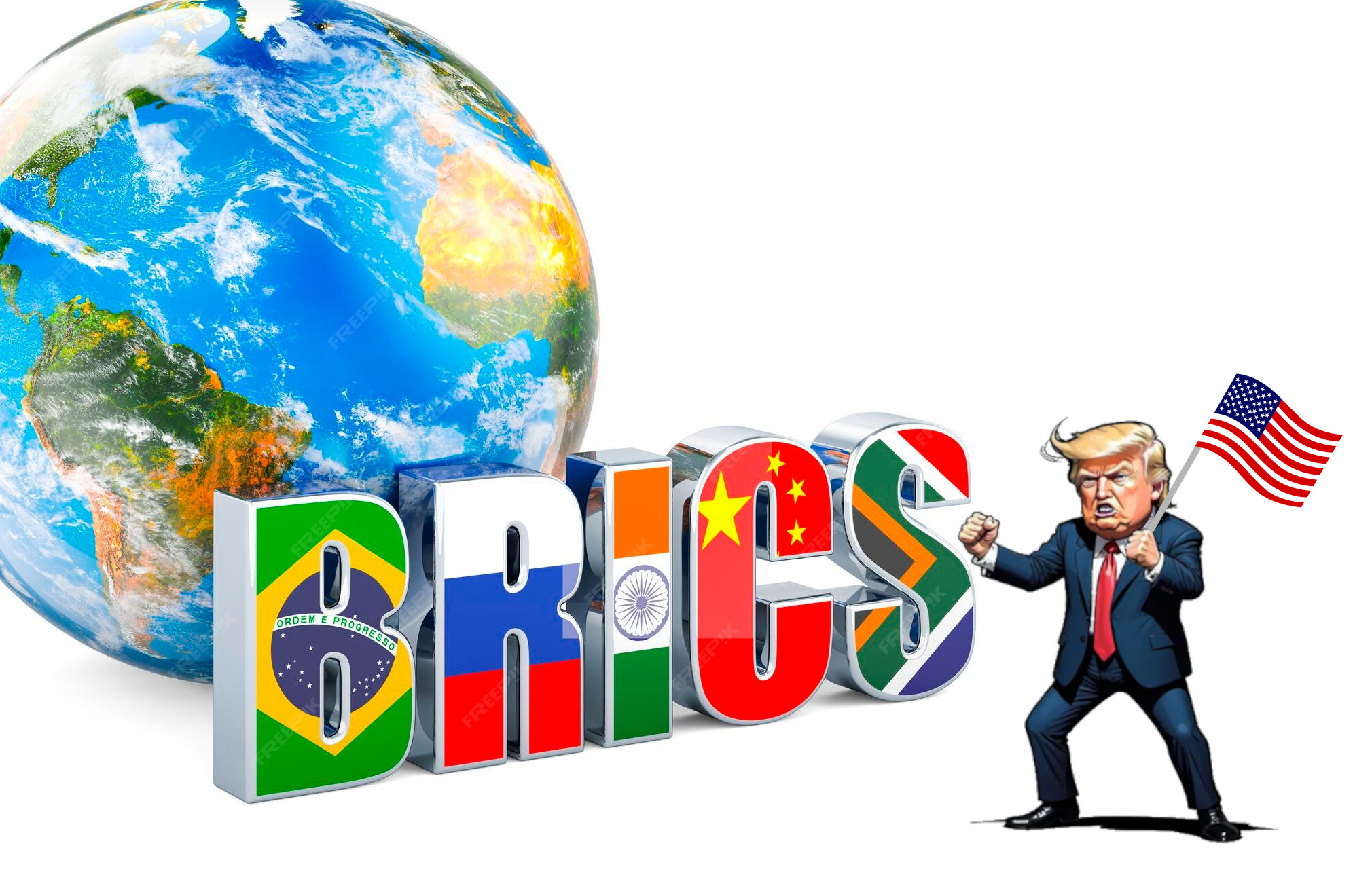
The realignment of international relations is accelerating in proportion to the increasing desperation of the Western ruling elites. Although the false beliefs of the military and economic superiority of the collective West seem still to predominate in their circles of political power, little by little reality is imposing itself. It is clear that the collective West is unable to defeat Russia militarily and that its economies cannot compete with the economy of the People's Republic of China. In their domestic politics, the attacks of the Western ruling elites against their own populations intensify via increased neoliberal economic repression, increased censorship and suppression of legitimate protest.
The tariff war declared by President Donald Trump has mutated from being mainly a tendentious and controversial trade policy to being yet another sinister campaign of illegal unilateral coercive measures. The application of punitive tariffs against Brazil, India and South Africa openly obeys the crude geopolitical revanchism characteristic of Yankee diplomacy of "do what we want or else...”. Quite predictably, the aggressive US trade policy towards these countries has turned out to be highly counterproductive.
India's strategic relationship with Russia has been strengthened and there is now greater momentum for an improvement in India's relations with China. The government of the Prime Minister of India, Narendra Modi, has canceled a visit to Washington by his Defense Minister and they have abandoned the idea of buying the US F-35 fighter jets that had been under negotiation. At the end of this month President Putin will visit Prime Minister Modi and subsequently both will be in China for the Shanghai Cooperation Organization summit and it is likely that both will have separate bilateral meetings there with President Xi Jinping.
In the case of the tariffs imposed on Brazil's exports by the government of President Donald Trump, President Lula da Silva has described them as blackmail, stating, "We don't need an emperor, we are sovereign countries." The main pretext for the high tariffs imposed on Brazilian products is that President Trump considers the judicial process against the opposition politician and former president of Brazil, Jair Bolsonaro, unfair. In any case, the tariff program includes exemptions for almost 700 of the 4,000 Brazilian products destined for the US market, which are 12% of the total exports of the national economy.
It is likely that South Africa will also defend itself against the 30% tariffs applied to its exports to the North American market. A significant increase in trade is now expected between the economies of Brazil, India and South Africa, the other two founding members of the BRICS+ group, China and Russia, and the new full members and partner members of the group. So the abandonment by the US elites of the regulatory framework of the World Trade Organization is being met by the decisive political determination and self-evident economic capacity of the leading economies of the majority world to defend themselves.
As for the US economy, Reuters news agency reported earlier this month that the manufacturing sector, a little more than 10% of the national economy, contracted in July for the fifth consecutive month and employment in the sector fell to the lowest level in five years. The tariffs applied to imports have raised the prices of imported raw materials that are required for manufacturing activity. The overall fragility of the American economy is evident from the fact that the high valuation of its stock exchanges depends on only seven technology companies and the all too obvious Artificial Intelligence bubble. It has been reported that more than 50% of the highest-valued American companies are reporting a significant decline in their profits this year and a third of the reported profits correspond to only ten of those companies.
The underlying productive weakness of the US economy also affects allied countries. The Wall Street Journal reports that, like the US auto manufacturing sector, its competitors in Japan, South Korea and Europe will take years to reorganize their supply chains to adapt to the new realities of international trade and the growing demand for electric vehicles. In 2025, the average decline in profits of the 10 largest manufacturers worldwide will be 25%. Toyota anticipates a decline in its profits of 44%. The impact of this broad commercial uncertainty causes political instability for the governments of countries that promote close relations with the North American government.
The main protagonists of global trade now give less importance to the efficiency of their supply chains and instead tend to prioritize geostrategic considerations. These new patterns of fragmentation in the international economy are due to the refusal of the Western ruling elites to peacefully negotiate a new arrangement of world power between themselves and the governments of the main powers of the majority world. Countries such as Brazil, India and South Africa which used to emphasize maintaining good relations with the US government are now putting more emphasis on defending their sovereignty.
In the case of Europe, the recent humiliating agreement between the head of the European Union and the Donald Trump administration imposes highly unfavorable trade terms for the European economy. The agreement renders absurd the EU's claim to be an independent third pole of global power, because it has essentially ceded its sovereignty to the US ruling elites. A deeper implication of this is that the ruthless class war by the US ruling elites against their own population will increasingly be reflected also in the domestic policies of the European ruling elites. The decision of the NATO country governments to allocate 5% of their respective GDP to military expenditures implies even greater application of the destructive neoliberal policies that have progressively damaged the human capital of their peoples for almost 20 years since the financial collapse of 2008-2009.
The Tass news agency reports estimates by the Russian authorities that losses in the European economy due to their countries’ coercive measures against Russia could add up to one trillion dollars. In 2014 the trade exchange between Russia and Europe was more than US$400 billion, now it has fallen to about US$60 billion. Europe continues to buy Russian oil and gas, but through third countries. This demented policy implies an energy cost 4 or 5 times higher than if hydrocarbons were purchased directly from Russia and explains why the cost of electricity in Europe has increased between 2 and 3 times, causing significant business closures and higher price inflation.
In the case of the US economy, a recent report states that for a typical low-income family in a city like New York, the cost of living has risen more than 130% while their income has risen only 75%. At the same time, public services and subsidies that supplement the health or food expenses of low-income US families are constantly being cut back. In fact, the growth of the US economy remains at less than 2% compared to last year, employment growth has stagnated and inflation remains stubbornly above the level projected by the country's central bank, the Federal Reserve.
At the global level, fragmentation and the impact of uncertainty on international trade imply less incentives for investment and greater inflationary pressure on the economies of Western countries. The challenge for the US and European economies is how they will be able to promote greater resilience through consolidation of their supply chains and greater technological innovation in order to remain competitive. By contrast, the planning of the Eurasian countries projects robust levels of investment in almost all sectors of economic activity. China’s Belt and Road Initiative with its partner countries is making significant progress with a record level of investment in the first half of this year reaching US$124 billion.
The Russian economy is thriving despite being the victim of more than 30,000 unilateral coercive measures by the US government and its allies and has increased its trade with the majority world by 1.5 times. Western companies that left Russia in 2022 lost almost $110 billion as a result and have now largely been replaced, mainly by their Asian competitors. Companies from US allies like Japan and South Korea such as Toyota, Hyundai and Kia are now negotiating the terms of their possible return to the Russian market.
A fundamental reality since 2022 has been the growing trade self-sufficiency of Russia and China relative to Western economies. These are still dependent on China as a supplier, while China has diversified its markets precisely so as not to depend on its exports to the West. Another example of the frustration of US political-economic power has been the failure of the attempt of the US company Blackrock to take over two key seaports in Panama, as part of the proposed purchase of 43 ports, owned by the Hong Kong company, C.K. Hutchinson.
The risk to Chinese trade of this transaction triggered an intervention by the Chinese government based on possible violations of Chinese trade legislation against monopolies. Now, the huge Chinese sea port company Cosco is expected to participate in the transaction so as to ensure the defense of Chinese business interests against hostile manipulation by the US government through Blackrock. The People's Republic of China's defense of its legitimate commercial interests in this way contrasts sharply with the European Union's surrender of its sovereignty to Donald Trump's brutal gangsterism.
For eighty years, US and European fascist neocolonialism has been the most sophisticated expression of organized crime in history. Now, Western countries are sustaining their policies of aggression around the world while self-harming their own countries in their desperation to slow the decline of their international power and influence. Finally, the leading countries of the majority world have the military strength, the economic power and, most fundamentally, the dignity to defend their sovereignty. Even so, the genocide in Gaza shows that it is still necessary to defeat once and for all current Western fascism, which has inherited the legacy of colonialism that terrorized the entire world for centuries.