
Stephen Sefton, January 26th 2025
 TcS Note: This article was written last January but it remains relevant in providing information about the context of the criminal Israeli attack against the population of the Islamic Republic of Iran.
On January 17th this year the Islamic Republic of Iran and the Russian Federation signed a Comprehensive Strategic Partnership Agreement between their countries for the next twenty years. For both countries, the agreement complements their respective existing association agreements with the People's Republic of China. Iran agreed to a strategic agreement with the People's Republic of China in 2021. The new agreement with Russia consolidates the development and security of the huge Eurasian region in the face of the aggressive policies of the North American and European elites and their governments.
President Putin commented that the agreement is “a real breakthrough, creating conditions for the stable and sustainable development of Russia, Iran and the entire region." Iranian President Mahmoud Pezeshkian stressed that "all regional problems should be solved by agreements between regional parties. We believe that the presence of external forces in our region can only exacerbate and destabilize the situation.” For Iran, the agreement promotes higher levels of investment in its economy that will help solve the serious problems caused by aggressive Western unilateral coercive measures.
In that sense, President Vladimir Putin highlighted the economic relations between Russia and Iran, "The growth of trade during the first ten months of last year was 15.5 percent, which is a good indicator. We are continuing with our major projects, including those of nuclear energy. There are also other emerging projects in the energy sector and good prospects in logistics... Tourist exchanges are growing, with an increase of about 21 percent. Transport communications are developing.”
The new agreement with Russia strengthens Iran's existing relations as a member of the Shanghai Cooperation Organization (SCO), BRICS+ and its close relationship with the Eurasian Economic Union (EEU). The agreement reflects the fundamental principles of this new order of international relations of collaboration towards a multipolar world based on respect and cooperation among equals. The agreement explicitly rejects foreign interference in internal affairs and the use of unilateral coercive measures; it highlights the imperative of an active promotion of regional and global peace and security and a robust defense of the principles of the UN and international law.
In specific terms of the bilateral relationship between Iran and Russia, the new agreement promotes and encourages greater cooperation against bilateral or regional military threats and greater cooperation between their intelligence services. It emphasizes its commitment to the promotion of peace in West Asia, Central Asia, the Caspian and Transcaucasia and mutual cooperation within the SCO and the EEU. It prioritizes a robust independent payment system based on the use of local currencies. It projects better regional transport infrastructure, especially the North-South International Transport Corridor. It prioritizes broader cooperation in the production and distribution of gas and oil and the development of nuclear energy for civilian purposes. It also promotes greater interaction in health, education and scientific research, greater cultural and sports collaboration and greater coordination in disaster prevention and mitigation.
Immediately, the main issue of importance is the rapprochement between Russia and Iran in military-technical and space matters. This implies that it is going to be progressively more difficult for Israel and its US patron to carry out another air attack on Iran, as they mounted in October last year. At that time, thanks to Russian cooperation, the Iranian air defenses thwarted the main attack, leaving as a result of the aggression relatively minor damage. The Israeli planes withdrew before reaching their target when they realized that they were marked and chased by the radars of the Iranian air defense system. Russia backed Iran with its intelligence, reconnaissance and surveillance resources, including satellite means and electronic warfare. The new comprehensive agreement with Russia now further deepens this strategic advantage of Iran to deter US criminals and their Zionist accomplices from another aggressive adventure in the future.
The Israeli regime and the US government, without having the slightest evidence, have always falsely accused Iran of developing a nuclear weapon. Now the new comprehensive partnership agreement explicitly defines collaboration between Russia and Iran in the development of nuclear energy for civilian purposes which definitively refutes the false Israeli and US accusations. Anyway, if Israel attacks Iran again, the country has already demonstrated that its missile capability with conventional warheads is sufficiently advanced to overcome Israeli anti-air defenses and destroy Israel without the need to have nuclear weapons.
Apart from their respective relations with Israel, in general, the foreign policies of Russia and Iran coincide on many points. President Vladimir Putin maintains excellent relations with Iran's Supreme Leader Ayatollah Ali Khameini. Both countries have been subjected to ruthless unilateral coercive measures by the North American and European governments. However, while the Russian economy has strengthened despite the economic aggression, Iran's economy has been affected very negatively, with problems of lack of investment and foreign exchange, high inflation, higher unemployment and higher levels of poverty.
Faced with the challenge of improving the national economy, President Mahmoud Pezeshkian favors negotiating with Western powers to try to achieve the relaxation and elimination of their coercive measures against Iran. But it is doubtful that the new US government could agree and although European governments could benefit from greater economic and energy exchange with Iran it is unlikely that they will challenge US power. In fact, the Western ruling elites think that they will be able to provoke a socio-economic collapse in Iran as they did in Syria. But, unlike Syria's economy, the fundamentals of Iran's real economy are very strong.
Iran produces 30.6 million tons of steel a year. In proportion to its population of 91 million, this is greater than the steel production of much larger economies such as Brazil, India, Indonesia or Mexico. Iran's industrial output of US$82.6 billion is higher in proportion to its population than the industrial output of India or Indonesia, and not far behind Brazil. Its electric power production of 357 terawatt/hours per year is slightly higher than that of Mexico and Indonesia and, in proportion to its population, higher than that of Brazil and India. These very strong economic fundamentals of Iran imply that its priority has to be to minimize the impact of the genocidal Western coercive measures by means of a decisive turn towards the Eurasian region.
Part of this process includes increased use of regional national currencies in their commercial and financial transactions. Much of Iran's regional trade is now done in national currencies and since 2018 the trade exchange between China and Iran has been increasingly done that way. Since last year, all trade between Iran and Russia has been done in rubles and rials, the respective national currencies of both countries. Russia's Mir payment system and its SPFS interbank payment system have been fully integrated with Shetab and SEPAM, their Iranian counterparts. The Shetab system has also been integrated with neighboring countries such as Qatar, Kuwait and Bahrain.
This process of de-dollarization will be an important defense against the threat of high US tariffs perhaps causing serious imbalances in the balance of payments of the countries of the majority world. Anyway, it is clear that Iran's further integration into the huge Eurasian economy is essential to defend its independence and national sovereignty. In this sense, the Comprehensive Association Agreement with Russia accompanies the process of finalizing the free trade agreement with the Eurasian Economic Union. And it also explains the relevance of the emphatic commitment of the new Agreement between Iran and Russia to promote peace in West Asia, Central Asia, the Caspian and Transcaucasia.
The NATO countries want to destabilize the region in order to prevent a new, more just and democratic world order. Türkiye, a NATO member country, and Israel are currently collaborating to achieve their expansionist goals in the region. Both Russia and Iran maintain important economic relations with Turkey but share the condemnation of the events in Syria where the aftermath of the destruction of Libya in 2011 has been repeated with similar nuances. It was Prime Minister Recep Erdoğan who plotted with Israel and its US patrons the catastrophe in Syria and imposed the terrorist groups derived from ISIS and Al Qaeda in the government, forces which have threatened the stability of the countries of the entire region since the 1990s.
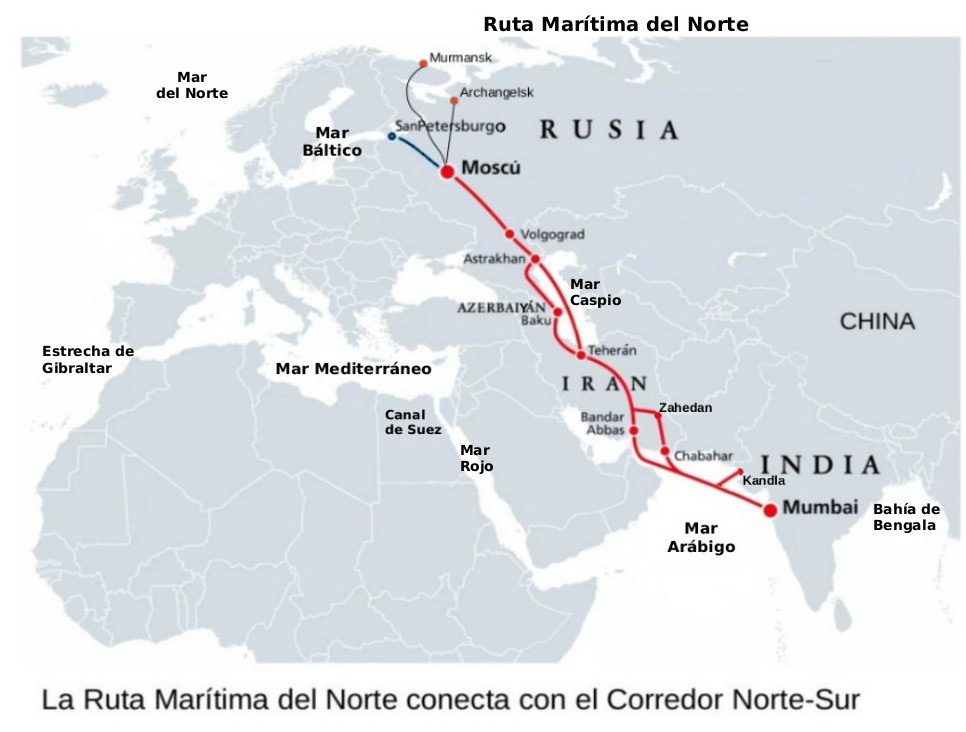
Another central component of the new strategic agreement between Russia and Iran to consolidate their economic and political relations is the development of the North-South International Transport Corridor. The Corridor has three branches and includes several sea routes and land connections by road and rail that will promote significantly greater trade between India, Central Asia, Transcaucasia, Eastern Europe and Russia. The Corridor allows greater commercial traffic from the ports of Mumbai and Kandla in India to Russia and Central Asia, and from these countries to East Africa. In addition, it reduces the transit time of commerce by more than 40% compared to the Suez Canal, with a cost reduction of about 30%.
Now Russia has agreed to build a major 162 km stretch of railway on the Caspian Sea coast between the cities of Rasht in Iran and Astara in Azerbaijan. Another major railway section scheduled to come into operation at the end of this year is 634km between the port of Chabahar in southern Iran and the Iranian city of Zahedan, on the border with Pakistan and Afghanistan. India and Iran signed an agreement last year handing over control of part of the Iranian port of Chabahar to India. Along with this crucial aspect of commercial land and sea transportation through the North-South Corridor via Azerbaijan, the new comprehensive agreement between Russia and Iran also contemplates the shipment of Russian gas to Iran with the possibility of reaching 55 billion cubic meters per year.
Azerbaijan is a dialogue partner of the Shanghai Cooperation Organization and has also declared its intention to join the BRICS+ group of countries. Both structures include China, India, Iran and Russia. The aspirations of all these countries in the region are developed based on the essential criterion of respect for the sovereign interests of nations and complementary cooperation for mutual benefit. It is these principles, and not Western-style zero-sum capitalist competitiveness, which guide the development of the Eurasian region. With its new strategic agreement with Russia based on these same principles, Iran's prominence now assumes even greater importance to ensure development, peace and stability in the region and in the world.