
Becca Renk *, January 15th 2025
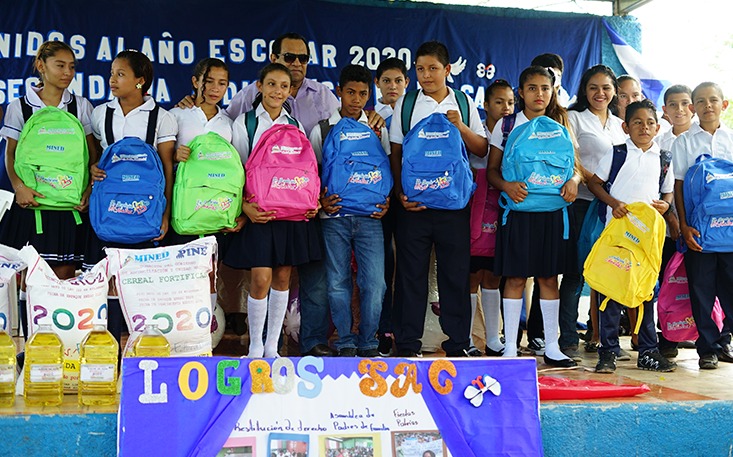
This week, Nicaragua’s Vice President Rosario Murillo announced that 500,000 school children will receive cash from the government to purchase school supplies.
“For this school year, which begins in the last days of January, all children in preschool, first and second grade will receive $55 each for the purchase of supplies to the child’s taste,” Murillo explained on January 6th. “We think that this way we are better off because everyone will find the backpack and the notebooks they like, the ones that make them happy to start school.”
This new initiative is an adjustment of government support for families with school-age kids which has been ongoing since 2007.
Revolutionary and Evolutionary
While Nicaragua’s revolution sticks to its fundamental principles - essentially those laid out by the FSLN’s Historic Program in 1969 - it is not afraid to evolve as well. This is what is meant when we say the Nicaraguan people are “revolutionary and evolutionary” - when a program isn’t working the way it was intended to, that program gets tweaked for improvement or even scrapped altogether in favor of a better way of doing things.
When the Sandinista government first came back into power in January 2007, President Daniel Ortega announced at his inauguration that public school would be free. The government had a huge task ahead of them just to repair the 27,000 completely deteriorated classrooms and train teachers – at that time, 47% of public school teachers had no formal training. But the government also wanted to make education accessible for all families.
No One Size Fits All
In order to do so, the government started a program to give each student a pair of shoes - the most expensive part of the school uniform. Our daughter Eibhlín was in first grade when she got a pair of these shoes – but they were big enough for a sixth grader! It turned out that the shoe donation, while a great idea, was a logistical nightmare – getting a million pairs of shoes and sending them to each school around the country, it was impossible to hand out the right sizes to each kid. We parents wound up trading shoes within the school as much as possible, some parents even sold the donated shoes for money to buy ones that fit.
As a result, the revolutionary support for families evolved. The shoe plan was scrapped and the Ministry of Education began instead to give out backpacks with school supplies. Each year of elementary school, along with one million other school kids, our daughters received colorful backpacks full of notebooks and other school supplies. This year, the program to support families getting kids ready for school has again been tweaked in order to improve.
Blessings and Victories
In December, the Ministry of Education concluded a six-month long consultation process which involved input from hundreds of thousands of students, teachers and families across the country to create the new National Education Strategy, “Blessings and Victories.” This constantly evolving strategy is based on a student, family and community-led model which informs everything from curriculum to overall pedagogical approach. It’s also a time for families to express themselves on all aspects of education, including things like their preference to pick their kids’ backpacks themselves.
As a result of families’ feedback, the backpack program has this year been traded for a cash transfer. This new program will put $55 in the hands of the families at the time they need to purchase school supplies. This will spread out the $27.4 million investment in education among a wide variety of small and micro businesses around the country, creating a welcome cash infusion for Nicaragua’s economy. Additionally, parents are empowered to spend the money on what their children need most for school: with the C$2,000 they will receive on January 15th, parents can purchase not only a backpack and notebooks, but it will also stretch to purchase a uniform or other needed items.
Graduation Bonus
This school bonus program is similar to the successful unconditional cash transfer program given to high school graduates in Nicaragua. In order to incentivize students to finish high school, the Sandinista government has distributed this special bonus to high school graduates for more than a decade. The transfer checks are made out to the students themselves – they must have their identification card (issued at 16 in Nicaragua) to sign for the check. It is a day of “adulting” – for most, it is the first time they will cash a check in their own name. The first bonuses were $30 each, two years ago the program was adjusted and the bonuses were raised to $82. In 2024, there were 63,717 graduates; the bonus program represented an investment of $5.24 million in Nicaragua’s youth.
Getting your kids back to school is expensive, no matter where you are or what type of school they are in. It’s gratifying to know that this year, the smallest kids in public school in Nicaragua will have the support they need to get them back in class.
* Becca Renk is originally from Idaho, USA. She has lived and worked in sustainable community development in Nicaragua since 2001 with the Jubilee House Community and its project, the Center for Development in Central America; she coordinates the solidarity work of Casa Ben Linder.