
Reverend Fred Morris, July 23rd 2022
Reflections on Sandinista Nicaragua today from a Gringo-Nica
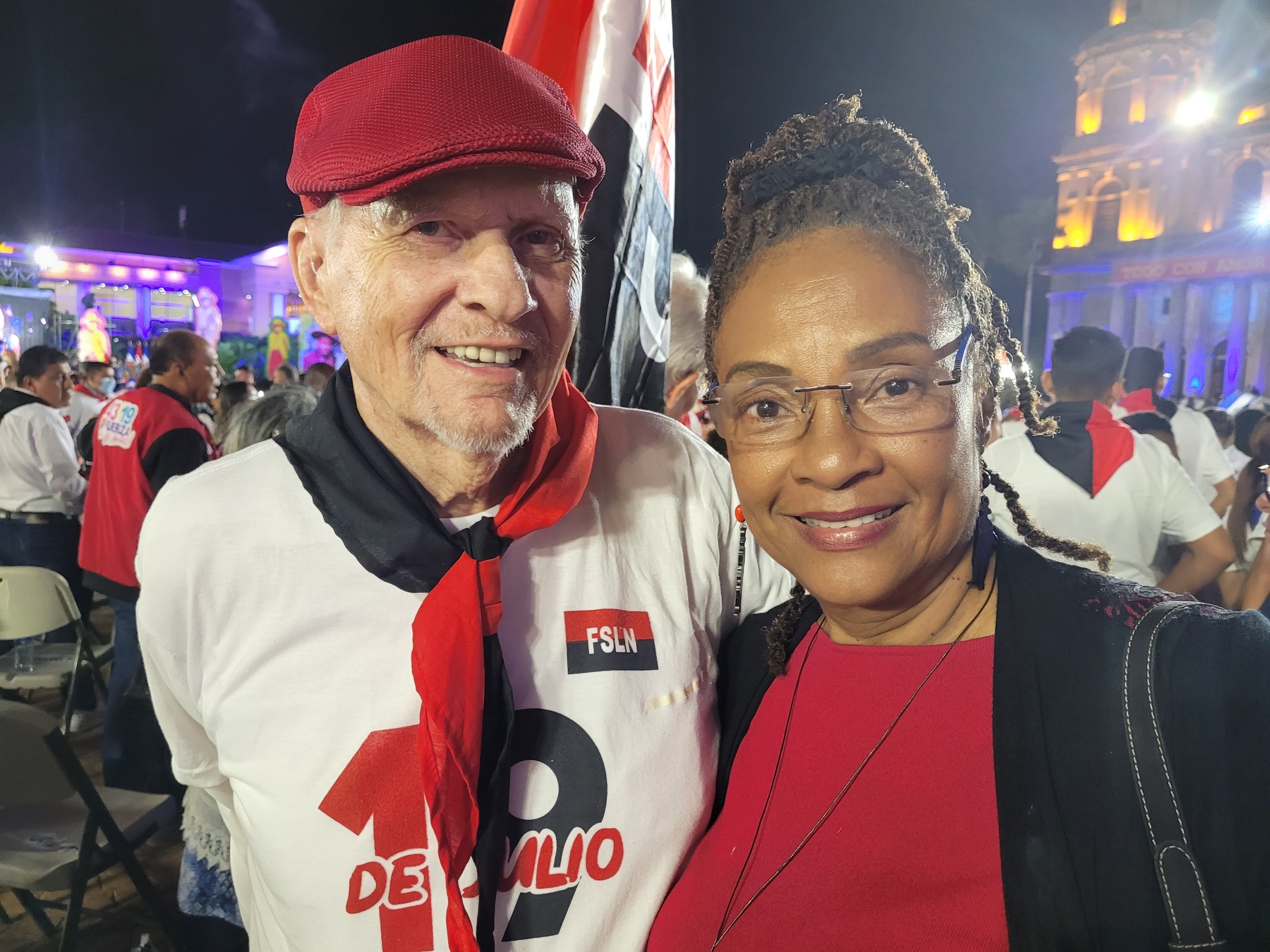
Reverend Fred Morris and compañera Argentina
I am now 88 years old and have lived seven of those years in Nicaragua. I became a Nicaraguan citizen just a year ago. We moved here permanently in June of 2021, when I retired after serving 68 years as a pastor of the United Methodist Church.
During my ministry, I served for eleven years as a Methodist missionary in Brazil (1964-1974). Just before leaving for Brazil, I was privileged to participate in the March on Washington in August, 1963, where I heard Martin Luther King, Jr.’s stirring I have a dream speech.
I arrived in Brazil on January 12, 1964 where my wife and I joined more than 80 other missionary candidates at a language school in Campinas, Brazil, where we would spend the entire year studying the beautiful language of Brazil, Portuguese. On April 1 of that year, the CIA led the Brazilian Army in a coup against the elected president João Goulart and established a military dictatorship that would rule the country for the next 21 years. The US Ambassador, Lincoln Gordon, declared to President Lyndon Johnson that “this event was the greatest victory for democracy of the 20th Century.” It brought in a regime of terror, torture, disappearances, murder and social repression that US citizens cannot imagine.
As a missionary, I worked with the poor people of Brazil, first in the Rio de Janeiro area and then, after a two-year hiatus at the University of Chicago where I got a Master’s degree in Urban Sociology, in Recife, in the impoverished Northeast of Brazil. Part of my assignment in Recife was to work with the Roman Catholic Archbishop Dom Hëlder Câmara, who today is in the process of canonization by the Vatican, an honor I’m sure he does not appreciate, as that same organization ignored and isolated him during the last 25 years of his ministry to the poor because of his constant denunciations of the barbarities of the Brazilian military against its own people.
In October of 1974 I was kidnapped by agents of the Brazilian Army in Recife because of my close relationship with Dom Helder and spent 17 days in their torture chambers in the headquarters of the Fourth Army of Brazil. Thanks to the energetic efforts of the Vice-Consul of the State Department in Recife, Mr. Richard Brown, and the Ambassador in Brasilia, John Crimmins, the government of General Ernesto Geisel decided that the bad publicity they were getting for having kidnapped and tortured a Methodist missionary was not worth it, I was expelled from Brazil as a “person prejudicial to national interests,” and warned that if I ever returned I would be imprisoned for four years, though I was never accused of any crime. (They didn’t realize when they decided to take me that the United Methodist Church in the US was the second largest Protestant Church in the country with more than 10 million members, nor that 100 of the 535 members of the US Congress professed to be Methodists!)
When my plane landed at JFK airport in New York, I was received by two executives of the Board of Missions of the United Methodist Church, who promptly took me to their headquarters at 475 Riverside Drive and fired me, with no explanation. Within an hour I found myself on the streets of New York without a job nor a place to stay.
For the next 20 months I lived in the DC area, looking for work, without success. I discovered that I was shit-listed by the Church on one hand and the US government on the other. I never got as far as a job interview. Finally, in June of 1976, out of desperation, I packed all my worldly goods into my 1969 car and drove to Costa Rica, where the Southwestern Petroleum Corporation (SWEPCO) named me their distributor of their roofing materials and I started my own company waterproofing roofs in that country.
In the spring of 1977 ABC-News asked me to be their radio correspondent for Costa Rica, which didn’t mean much in those days: an occasional story about Robert Vesco, the US financier who ran off with $247 million he stole from a mutual fund he had established for school teachers, and an occasional earthquake large enough to make the news.
However, on October 13, 1977 an event took place in San Carlos, Nicaragua that was to change the history of Nicaragua and the region and my own life as well. A group of muchachos, as they were called, launched an attack on the Somoza National Guard post in San Carlos, on the San Juan River, literally wiping it out. But Somoza sent reinforcements and the muchachos were forced to flee to Costa Rica for safety. A couple of days later I interviewed some of them for ABC-News. Among the group was Father Ernesto Cardenal and a young guerilla fighter named Laureano. Both were to become famous names in the Sandinista Insurrection and subsequent Revolution.
As I knew nothing about Sandino and Sandinismo, I was intrigued enough to begin reading some of his writings and of the history of his struggle against the US occupation of Nicaragua during the first half of the 20th Century. Though I had been a history major In college, I knew nothing of this—and I checked my history books and found no mention of those events.
In 1909 the Marines landed in Nicaragua to collect debts owed to an American bank (Brown Brothers of Boston), and then staying to be sure everything went well for American interests. In 1927 Augusto C. Sandino, a Nicaraguan peasant, gathered a handful of compatriots and declared war on the US Marines. Over the next five-plus years. Sandino and his band of merry men fought the Marines—and won. By 1933, the impact of the economic Depression in the US and its inability to defeat Sandino and his guerilla forces, led the US to decide it wasn’t worth the losses it was suffering, and it declared a victory and went home. But before leaving it cloned a military force called the National Guard out of the Marine Corps and turned it over to a man named Anastasio Somoza Garcia. His remarkable qualifications were that he had earlier on been a used car salesman in New Jersey and spoke excellent English. As none of the US military officers had ever bothered to learn Spanish, that made him “their man.” So they turned the National Guard over to him.
On February 21, 1934, Somoza and President Sacasa had reached an agreement with Sandino to put an end to the guerilla war and Sandino’s men laid down their arms. Sandino accepted an invitation for a dinner at the presidential palace, together with his brother Socrates, and two of his favorite generals. After the meal, the four were taken out and executed by Somoza’s people.
Within a year, Somoza effectively fired President Sacasa and made himself president and his family ruled Nicaragua ruthlessly until July 1979.
In 1961, Carlos Fonseca and Tomas Borges organized the Frente Sandinista to begin anew the struggle for Nicaraguan independence. After a bloody struggle that began with the attack on the National Guard post in San Carlos on October 13, 1977, and cost the lives of 50,000 Nicaraguans (out of population of a bit more than three million), on July 17, 1979 Somoza fled to the United States and on July 19 the Sandinistas took control of the country.
Before the Victory, the Sandinistas formed the Junta de la Reconstrucción. This was a group of five persons, two militant Sandinistas, Daniel Ortega and Moises Hassan; Sergio Ramirez, noted intellectual and author; Violeta Chamorro, widow of anti-Somoza newspaper publisher and Alfonso Robelo, businessman. The three who were not militant Sandinistas were in Costa Rica awaiting the end of the battles. As ABC-News’ man in Costa Rica, I was in constant contact with them. Moises and Daniel were in Nicaragua, still fighting.
This Junta had been formed by the Sandinistas in order to please President Jimmy Carter, who was appalled by Somoza’s violence against his own people, but who was under pressure from the CIA/Pentagon/State Department not to accept the Sandinistas, as they were suspected of being Communist.
The Junta served as the interim government until the elections held in 1984. 75% of the eligible voters took part and the Frente Sandinista de Liberación Nacional (FSLN) got 67% of the votes. Two days later, Ronald Reagan was re-elected president of the US.
Reagan never could distinguish between Sandinista and Comunista and being a fanatic anti-Communist, he was totally against the Sandinista government. He had already re-armed those members of Somoza’s National Guard who had fled to Miami with Somoza and sent them back to Nicaragua to wage war against the Sandinista government. The US Congress opposed this action and passed the Boland Amendment, which prohibited any form of US support for actions against the elected government of Nicaragua. That Amendment passed without a single opposing vote. But Reagan ignored Congress and with Colonel Oliver North began the Iran-Contra actions, selling arms illegally to Iran and using the profits to buy weapons for the contras. This was totally illegal and resulted in the conviction of Ollie North for criminal actions, which required a pardon from Reagan. The contras were not successful in overthrowing the Sandinista government, but they did manage to murder another 30,000 Nicaraguans.
The Sandinista government went to the International Court of Justice at The Hague, denouncing the war of aggression carried on by the United States against Nicaragua. On June 27, 1986 the Court ruled in favor of Nicaragua and ordered the US to cease and desist and pay $17 billion in reparations to Nicaragua. Reagan promptly withdrew the US from the Court.
George H. W. Bush replaced Reagan as president of the US in 1988, taking office in January of 1989. To prove to the world that he was not a “wimp”, in December of 1989 he invaded Panama to capture Manuel Noriega. Noriega had been a CIA agent for many years, receiving some $200,000/year for his services. He coupled that with his drug trafficking, plus he salary as president/dictator of Panama to provide a comfortable living for himself. But in 1988 he betrayed his masters and took part in the Contadora Peace Process in Central America that was seeking to bring an end to Reagan’s genocidal wars against the peoples of Nicaragua, Honduras, El Salvador and Guatemala. Reagan had been shoring up the murderous militaries in the three non-Sandinista countries, which had been defending the wealthy oligarchies since the Spanish Conquest, under the rubric of “fighting Communism.”
When Noriega decided to support the Peace Process, Bush decided he had to go and publicly denounced him as a drug dealer, which he had been all along, enjoying the blind eye of his Imperial masters. So on December 20, 1989, the US military made a blitz nightime attack on Panama, which resulted in the deaths of several thousand Panamanian citizens. (The Panamanian Red Cross said the number was 4,000, but that number was not provable as US Army bulldozers rolled out of the Canal Zone during the night and buried the majority of the victims in mass graves before daylight.) The US Air Force used its brandnew Stealth Fighters for the first time. Panama had no defenses.
The US effectively occupied Panama for a month until Noriega was finally handed over and taken to the US where he was tried, convicted and sentenced to 25 years in prison.
In January 1990, the US put forth Violeta Chamorro, the widow of Pedro Joaquin Chamorro, publisher of La Prensa newspaper, which had openly opposed Somoza until his murder on January 10, 1978. His assassination by Somoza added to the popular support for the Sandinistas in the Insurrection. Dona Violeta, his widow, was presented by the US Embassy as the “Unity” candidate for all of the parties opposed to the Sandinistas. With total support from the US, which included several million illegal dollars for her campaign, and President Bush declaring publicly after his “successful” invasion of Panama, “I hope the people of Nicaragua are paying attention,” she won the presidency in February of 1990.
This began a period of 17 years of neo-liberal governments in Nicaragua. Violeta presided over the sacking of the country. She actually sold the entire railroad system to China: rails, switches, rolling stock. Only left the stations. And the money received disappeared. She was followed by Arnoldo Aleman, who continued plundering of the country, providing nothing for the people. And then Enrique Bolaños. But in 2006 Daniel Ortega managed to win by a narrow margin and the FSLN returned to power. Ortega was re-elected in 2012 and again in 2017 and again in 2021. In the latest election the Sandinistas got 76% of the votes cast, with the second place party getting 12%.
Why are the Sandinistas so popular in Nicaragua today:
Nicaragua is a very poor country. Only Haiti ranks lower in the hemisphere. But during the time the Sandinistas have been in power, since 2007, poverty has been cut in half! Absolute poverty has been reduced from 28% to around 8%. The government has built 25 hospitals since 2008, compared to none during the precious 17 years. They have paved more than 6,000 miles of roads, which has transformed the lives of several million people living in formerly inaccessible rural areas. The Sandinistas have opened more than a thousand Health Posts throughout the country, which provide basic health care for free. Birth control is provided for free throughout the country. There are hundreds of Maternity Homes throughout the country where pregnant women can go before giving birth and stay for a month or two after to be sure that all is well with the new arrival—all free.
Infant mortality is now at 13.8/1,000 births, down from r21 in 2007. Nicaragua ranks in the top 10 in the world in gender equality. It is No. One in the world in the percentage of women in positions of authority, from Members of Congress to Police Captains, to Mayors, etc. In every police station there is a female officer to receive complaints from woman about domestic abuse and related problems. Thousands of women have received interest-free micro loans to enable them to open a small business. Pregnant cows and sows are given to women heads of households in the countryside to improve protein intake as well as income.
The Sandinista government is popular with the majority of the people because they have received direct and perceived benefits, something that has never happened before.
Why does the United States hate Nicaragua so much? Why does it carry out its vicious campaign of lies against the country?
Since the Sandinista victory over the Somoza dictatorship in 1979 the United States has not ever let up in its efforts to overthrow the government and establish a regime that will be obedient to the wishes of the Empire. The key word is obedience.
Since the declaration of the Monroe Doctrine by President James Monroe in 1823, the United States has insisted on obedience by the countries of the hemisphere. The US military, usually the Marines, have landed in every country in the hemisphere with the exception of Costa Rica and Brazil. Costa Rica because it was not deemed necessary to land troops as the country was totally committed (sold out) to the US and Brazil because the problems relating to any kind of invasion were nearly insurmountable. The geography and the size of the country led the US to seek diplomatic solutions rather than gunboats.
The US has overthrown governments, established friendly dictatorships and generally ruled the roost throughout the hemisphere since fairly early in the 19th century. As I mentioned above, it actually landed troops and occupied Nicaragua more than once. I didn’t mention the William Walker invasions of mid-19th Century, financed by the US Congress.
But the hatred and anger of the US toward Nicaragua since the Sandinista Victory in 1979 is based on 1) disobedience to the Empire, and; 2) the setting of a bad example for the other countries of the hemisphere.
The United States, through its very effective propaganda mechanisms, the Western media, directed very effectively by the CIA/State Department/Pentagon operatives carries on a relentless campaign of misinformation and outright lies about Nicaragua.
For instance, in November of 1982, Newsweek magazine had on its cover a funeral pyre of dozens of bodies being burned, allegedly Mosquito Indians on the Atlantic Coast of Nicaragua being burned by Sandinista troops. However, within days it was proven that the photo was of a funeral pyre in the country of India and had nothing to do with Nicaragua. But no apology or correction was ever published and the image remains to this day in the minds of many in the US of the “barbarity” of the Sandinistas.
More recently, in June of 2021, the police in Nicaragua arrested 17 persons who were accused of money laundering. They had received more than $100 million from USAID, NED (National Endowment for Democracy) (a CIA front) and the Heritage Foundation, another Congressional-funded outfit to carry on CIA activities of regime change. The Nicaraguan government has a law like the US that requires that any person or organization that receives significant funds from a foreign entity has to report those funds and their intended uses. None of the arrested persons had complied with that law.
The US insisted that five of those persons were candidates for the presidency who were being arrested to prevent their competing with Daniel Ortega. The facts are that not one of them was even a member of a political party and there was no party in Nicaragua, among the 14 parties in activity, that even considered any of them to be their candidate. Furthermore, in June 2021, there were no candidates for the presidency, as the Electoral Law required the registration of candidates to begin toward the end of July. But the US insisted, through its propaganda machine, that these people were “political prisoners” to keep them from being opponents to Daniel Ortega. One of the persons arrested was Cristiana Chamorro, daughter of Violeta, former president. She had been touted by the Embassy as a possible “Unity” candidate, as had been her mother in 1990, even though Cristiana had never had any political activity during her 68 years. (She was later tried and convicted of money laundering, having received more than $20 million from USAID, etc., without declaring those funds, and apparently some $7-8 million ended up in her personal accounts, with the rest going to groups aiming for regime change. She is now serving 8 years in prison—house arrest, in recognition of her “illustrious” family.)
A recent article in El Pais, a major Mexican newspaper, regurgitated all of the above, especially focusing on the fate of some ex-Comandantes, like Dora Maria Tellez and Hugo Torres.
Dora Maria Tellez was a comandante of Sandinista troops in the Leon area during the fight against Somoza. She was only 23 and became a darling of the Sandinista supporters in the US. She was heroic and exemplar in those days. During the 90s, she was the Minister of Health, in recognition of her having been a medical student before the Insurrection. She was effective in that role. But after the defeat in 1990, she sort of lost her way. It turns out that her family was quite wealthy and she sort of “went home”. In 1994 she joined forces with former VP Sergio Ramirez to form an opposition party, the MRS. In the 1996 elections, Sergio was the presidential candidate for the MRS. However, they got fewer than 2% of the vote, which according to the Electoral Law that was established under Violeta, meant that they could not even field candidates in future elections. In 2018, when the Embassy orchestrated a violent attempt at Regime Change, which killed more than 200 persons, 24 of them Sandinista police persons, Dora Maria was out in the streets with a bull horn urging on the rioters. When the coup failed, she went to Washington, DC, and met with members of Congress asking that the US invade Nicaragua and overthrow the elected government. That is treason by anyone’s definition. She was tried, convicted and is serving a 15-year sentence for treason.
Hugo Torres also participated in the disaster called MRS. He was suffering from terminal cancer when he was arrested and died in jail, not from bad treatment but from his prior cancer.
I’m sure the New York Times and Washington Post will be quoting the El Pais article soon to “prove” how bad the Sandinistas are.
I should also note that during the attempted coup in 2018 the National Conference of Catholic Bishops of Nicaragua offered to be mediators between the Sandinistas and the golpistas. At their very first meeting the Bishops insisted that Daniel should resign, even though he had won reelection with 72% of the vote in 2017. One of the bishops, Bishop Silvio José Baez, was videoed encouraging protesters in the torture of Sandinistas. After the coup attempt failed, more than 500,000 Nicaraguans signed a petition demanding his removal from Nicaragua. The Vatican called him home where he stayed for a few months. He is currently without assignment, but living in Miami serving as chaplain to the gusanos from Cuba, the turncoats from Venezuela and the traitors from Nicaragua with unexplained sources of support.
Allegations are made repeatedly by the Western media and groups like Amnesty International and WOLA (Washington Office on Latin America) about torture in Nicaragua and the lack of free speech, etc., claiming that Ortega has become a ruthless dictator. Their sources for proof of torture are a human rights organization that was formed and funded by the Embassy back in the 80s to demoralize the Sandinistas and makes unfounded allegations regularly.
Having lived under a US-sponsored military dictatorship for nearly eleven years in Brazil, and having been tortured by the same, I can assure you that the Sandinista government is not a dictatorship. During my time in Brazil no one, and I mean no one, would ever express a criticism of the government, even in family gatherings, as one could never be certain as to who was plugged into the national security system. If one said anything negative about the government, or the economy, or anything except the weather, you could disappear the next day. Period.
No one ever talked about anything in a public place, like a restaurant, except for soccer and girls. The waiter, or people at the next table, might report what you said and bye-bye.
My neighbor here in Managua worked for Channel 10 TV, a Nicaraguan equivalent of Fox News, which shouts out lies about the government every day. And nothing happens. Many of my neighbors in our middle class neighborhood are not Sandinistas but are not reluctant to say so. No one is afraid to express their opinion. And no one is disappearing. No one has a son or daughter or father or mother or aunt or uncle who has been tortured by the secret police.
I learned In Brazil that the purpose of torture is social control, not information gathering. The repressive governments know that a little bit of torture goes a long way in controlling a population so they don’t make a secret of it. They regularly release victims of torture so they can go home and tell others what happened to scare the shit out of the whole population. And it works. But no one in Nicaragua is afraid of the government.
Again, Nicaragua, since 1979, has been and is a bad example for the rest of the hemisphere. This has become worse since they regained power in 2007, as the benefits they have gotten for their people are incredible, even as Nicaragua is still one of the poorest countries in the Americas. But by demanding their sovereignty and dignity, even in the face of violent opposition by the US, the Empire, they are showing all of the countries of the Americas that there is another way. It is possible to be disobedient to the will of the Empire. A country can stand on its own feet and insist on it sovereignty and dignity.
The Empire wants to destroy Nicaragua because it is afraid that the disease of dignity and independence might spread. If Nicaragua is allowed to continue to succeed, maybe others will follow that path.
A final note: since the conflict in Ukraine has become a real war between Russia and the European Union, egged on and sponsored by the Empire, the US has been too busy and too desperate trying to whistle and wind its watch at the same time that it doesn’t have time to really get involved with Nicaragua. The sanctions the US put on Russia have backfired so effectively that all of Europe is in economic chaos and facing total calamity when winter comes and there is no gas to heat the homes of their citizens. And inflation is galloping away at more than 10% throughout the area. (In Nicaragua inflation is at 5.9%).
I have been a US citizen since my birth in Oklahoma City in 1933. I have been a citizen of Nicaragua since July 2021. I am honored to be a citizen of this marvelous country that is showing the world how to live with dignity and how to improve the lives of all its citizens, not just the 1%. My deepest and heartfelt thanks to the people of Nicaragua for allowing me to be part of their struggle.