
Dee Knight, Hollywood Progressive, September 2nd 2023
https://hollywoodprogressive.com/literature/sandinista-nicaragua
A review of "Nicaragua: A History of US Intervention and Resistance," by Daniel Kovalik
Four decades ago, as Ronald Reagan mobilized former soldiers of the Somoza dictatorship to strangle the Sandinista Revolution, there was a flood of support and solidarity for what many considered an amazing social experiment. I lived in Nicaragua during the late 1980s, and witnessed how the Sandinistas were able to lead a transformation of one of the poorest countries in Latin America. So did Daniel Kovalik, whose new book tells the story dramatically and beautifully.
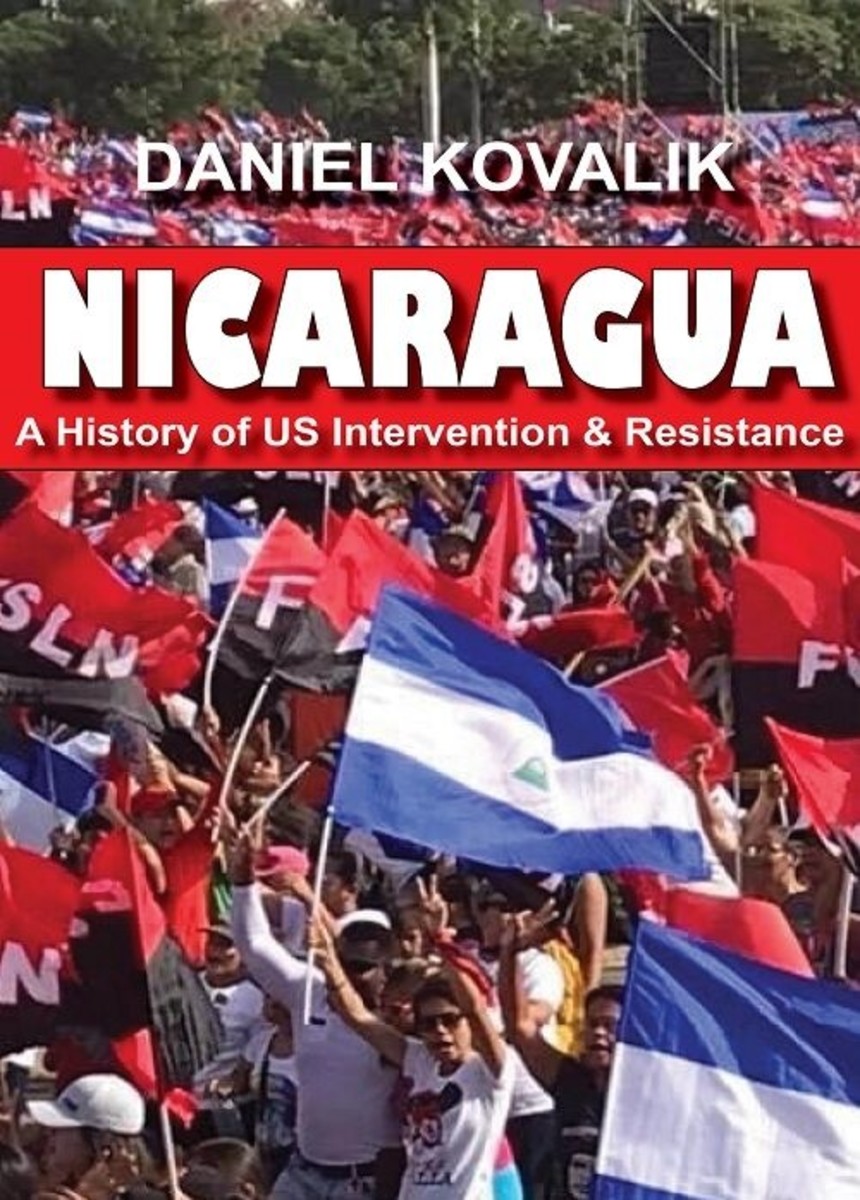
During the 1980s Reagan’s aid to the contras was widely recognized as a brazen and illegal attempt to stop a thoroughly popular and democratic uprising against a corrupt and brutal dictator. Somoza even bombed his own people. Kovalik provides a detailed history, not only of the Sandinista Revolution, but also its original hero, Augusto Sandino, who waged a successful rebellion against US occupiers in the late 1920s. He was murdered when he came down from the mountains to Managua to negotiate peace. Kovalik relates how Sandino’s followers, both in the rugged mountains and the cities of Nicaragua, kept his memory alive and forged the Sandinista Front for National Liberation (FSLN) in the 1960s and 70s. He tells how the Sandinistas redistributed Nicaragua’s fertile land to the peasants (after it was abandoned when Somoza fled to Miami), mobilized university students to go to the countryside and teach people to read and write, and sent doctors and health workers to set up clinics to care for people’s health, which had been ignored for decades during the Samosa dictatorship.
All this resulted in a massive Sandinista victory in the 1984 elections. But as the Contra war took its toll, massive US sponsorship of oligarch candidate Violetta Chamorro dealt the Sandinistas a demoralizing defeat in 1990. Chamorro’s electoral campaign received nearly $20 million from the US. Her neoliberal policies reversed the gains of the first Sandinista decade, as the land reform was overturned and illiteracy and bad health made comebacks. The neoliberalism regime lasted 16 years.
Some Sandinista leaders fell away after the 1990 electoral defeat, along with their middle class allies. That left Daniel Ortega as the surviving member of the original Sandinista leadership. He divided his time between leading the Sandinista bloc in the national assembly and visiting long-term Sandinista supporters in the countryside and the mountains.
Erosion of Support in North America
A substantial fraction of North American supporters also fell away when former vice president Sergio Ramirez and former health minister Dora Maria Tellez formed the Sandinista Renovation Movement (MRS) – which influenced some former US supporters, such as Democracy Now, NACLA, and others. (MRS now calls itself the Unión Democrática Renovadora, or UNAMOS.) Kovalik notes that MRS had much more support abroad than in Nicaragua: in 1996 MRS presidential candidate Sergio Ramirez won less than half of one percent of the vote while Daniel Ortega won 37.8 percent. Six years later the MRS presidential candidate got 6.4 percent while Daniel Ortega won 38 percent. The FSLN expelled Ramirez in 1994 “because of his position of wanting a less adversarial relationship with Chamorro.” He and other MRS assembly delegates also tried to “pass legislation which would have prevented any former president from serving another term in office.” The fact that Ramirez “had never participated in the armed struggle that led to the Sandinista victory in 1979” was another factor against him among Sandinistas. The MRS openly supported the 2018 attempted coup, and “has been colluding with the US government against the Sandinistas for years,” Kovalik writes, with ample documentation by Ben Norton published in The Grayzone. Norton lives and works in Nicaragua.
Kovalik himself went to the mountains and interviewed some long-term Sandinistas. In March 2022 he spoke with Lola Del Carmen Esquivel Gonzalez, who had been supporting the revolution since the age of 14, starting back in 1976. “At that young age, she was already organizing unions and youth,” Kovalik writes. “After the Triumph, she joined the Literacy Crusade and went out and taught fellow peasants how to read and write. The other tasks she took on were defending the 2,100 manzanas (approximately 3,500 acres) of land which the revolutionary government had distributed to peasants in her region. When the Contra war came, she and other women kept the land productive while the men went out to defend the country.” Kovalik asked Lola what the revolution meant to her. This is what she said:
One of the biggest benefits of the revolution is that we can live well. We have between 80 and 90 social programs – education, land, health care. We have food sovereignty… We are the revolution, and we have been able to improve our lives… We have water, we have land, we have love, we have life, we have peace. We feel quite happy…. We are not in war even though they want us to be. I’m 60 years old. I have 11 children. I feel young and ready to defend the revolution.
When Daniel Ortega and the Sandinistas won the 2006 elections they restored free education and healthcare, and launched anti-poverty programs such as Zero Hunger, Zero Usury, Zero Unemployment, and Streets for the People. This is the “authoritarianism” the US officially hates, since it tends to limit the power of big business. “Food sovereignty” means Nicaraguans grow nearly 100 percent of their food themselves. That makes it harder for the US to strangle them.
Nicaragua has had the highest growth rate in Central America in recent years, according to a July 2018 report by Task Force on the Americas. Annual minimum wage increases at five to seven percent above inflation have improved workers’ living conditions and lifted people out of poverty. The poverty rate fell by 30 percent between 2005 and 2014. Nicaragua’s police force is internationally recognized for innovative community policing policies. Unlike neighboring El Salvador, Honduras, and Guatemala, where terrorized families have been fleeing to the US border, Nicaragua has minimal gang violence or organized drug cartels. Education is free from pre-school through college and graduate school. There’s one month’s paid vacation, 13 paid holidays and an extra month’s pay each year.
What About the 2018 Coup Attempt?
So why was there an attempted coup against the Sandinistas back in 2018? Kovalik writes that Daniel Ortega was very popular going into 2018 elections, with an 80% approval rating. He cites a New York Times report in April 2018 that Ortega was especially popular among the poor, “who received housing and other government benefits support.” He adds that “as far as the US government was concerned something had to be done about Ortega’s strong popular support, and so the US Congress initiated legislation targeted at destroying his popular social programs.” Kovalik details the 2017 Nicaragua Investment Conditionality Act (NICA Act) and the later RENACER Act, both of which were designed to smotherb Nicaragua. Trump’s Secretary of State Mike Pompeo “openly declared that the objective of the US is to destabilize and change the government in Nicaragua, along with the governments in Cuba and Venezuela – the countries [Pompeo] deems to be the Axis of Evil in the hemisphere.”
Kovalik details and documents how the US State Department, National Endowment for Democracy and USAID poured $200 million into its allies in Nicaragua to oust the Sandinista government. He cites a NED-funded publication, Global Americans, “Laying the groundwork for insurrection: A closer look at the US role in Nicaragua’s unrest,” which explained that while “the international press has depicted the rapid escalation of civil unrest in Nicaragua as a spontaneous explosion of collective discontent… it’s becoming more and more clear that the US support has helped play a nurturing role in the current uprisings.” This “nurturing” included millions for youth groups and civic organizations which participated in the uprising. US funds covered “the cost of transport to move hundreds of militants” from city to city, and paid a daily stipend to participants in the coup.
Kovalik cites a study that revealed “the opposition extremists who hijacked the student protests for their own ends were well organized, funded and prepared long before the protests ever began.” But Nicaragua’s workers and peasants resisted, “and helped to defend the government and the economy, which the opposition was trying to undermine and destroy in its effort at regime change, just as the Contras had done in the 1980s. Kovalik cites a Counterpunch article from 2018 which said “La Via Campesina, the National Union of Farmers and Ranchers, the Association of Rural Workers, the National Workers’ Front, the indigenous Mayangna Nation and other movements and organizations have been unequivocal in their demands for an end to the violence and their support of the Ortega government.”
Two major groups involved in the attempted coup were Nicaragua’s chamber of commerce (COSEP) and far-right leaders in the Catholic church hierarchy (many of them members of the fascist Opus Dei group), who were demanding that Ortega resign. (Many of the Opus Dei members were later withdrawn by the Vatican at Nicaragua’s request.) Some opposition leaders “were openly calling for US intervention to overthrow the Sandinista government.”
A leader of the Rural Workers Association (ATC) told Kovalik in a March 2022 interview that “big business called for work stoppages, but the people kept the buses and small businesses and farms going. Food sovereignty was never interrupted… All of the union movement made sure the economy kept going… The workers kept production going.”
US ‘Progressives” believe NED and USAID
Faced with unrelenting hostility and destabilization by the US National Endowment for Democracy (NED) and Agency for International Development (USAID), the Sandinista Revolution should be very easy to defend politically. But as Daniel Kovalik explains, far too many people in the US actually believe what NED and USAID have said, as the mainstream media has parroted their claims. These people seem to swallow the neocon idea that if an independent country tries to take control of its own economy and improve the lives of its people it is bad, and regime change is urgently needed.
Daniel Kovalik launched Nicaragua: A History of US Intervention & Resistance two days before this year’s July 19 celebration of the 44th anniversary of the Sandinistas’ 1979 triumph. The event took place at the Ben Linder Center for Solidarity – named for the young American engineer and solidarity activist who was murdered by Contras in the mountains near Jinotega in 1987. I sat in the audience, listening to Kovalik declare that Nicaragua can continue to count on the solidarity of US anti-imperialist activists. Daniel Ortega, speaking at the anniversary rally two days later, responded, saying “we see and feel [this solidarity] every day when you write and defend the truth… about Nicaragua.”
The opinions expressed here are solely the author's and do not reflect the opinions or beliefs of the Hollywood Progressive.
* Dee Knight is the author of A Realistic Path to Peace, due to be published this year. His political memoir, My Whirlwind Lives, was published last year by Guernica World Editions.