
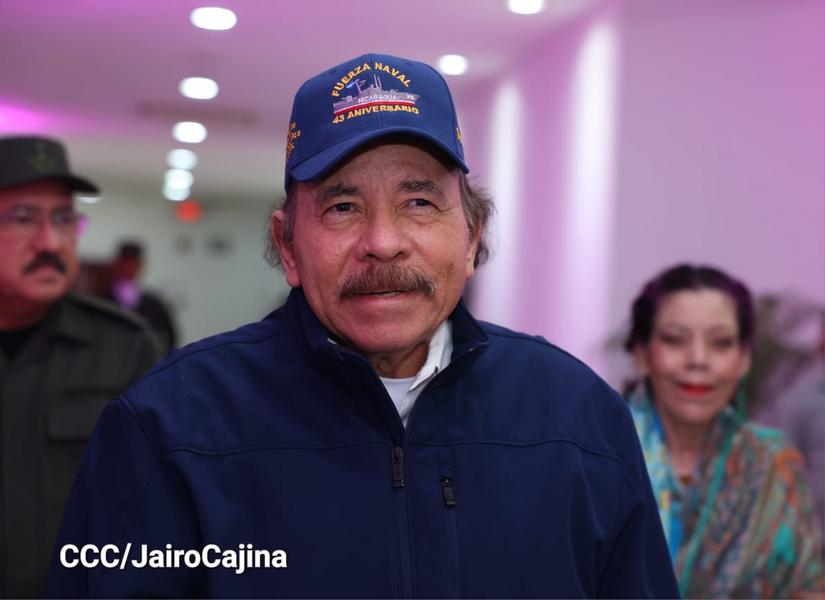
Commemoration of the 43rd Anniversary of the Naval Force of the Army of Nicaragua
August 14th 2023
Address by Daniel
Nicaraguan brothers and sisters, families of these Lands of Darío and Sandino. Compañera Rosario, Vice President of the Republic; beloved brother, Army General Julio César Avilés Castillo, Commander-in-Chief of the Nicaraguan Army; beloved brother, Compañero Doctor Gustavo Porras Cortés, President of the National Assembly; beloved brother, Compañero Abel Enrique Prieto Jiménez, Advisor to the President of the Republic of Cuba, Miguel Díaz-Canel.
Beloved brother, Major General Bayardo Ramón Rodríguez Ruiz, Chief of the General Staff of the Nicaraguan Army; beloved brother, Inspector General of the Nicaraguan Army, Major General Marvin Elías Corrales Rodríguez; beloved brother Rear Admiral Ángel Eugenio Fonseca Donaire, Chief of the Naval Force of the Nicaraguan Army.
Beloved Minister of Defense, Compañera Rosa Adelina Barahona Castro, beloved Sister; beloved brother, First Commissioner General Francisco Javier Díaz Madriz, Director General of the National Police; beloved brother, Commissioner General Horacio Rocha López, Minister Advisor to the President for Security Issues of the National Police; beloved brother, Commissioner General Zhukov Serrano Pérez, Deputy Director General of the National Police.
Beloved Officials, Directors, Ministers of the different Government Institutions; brothers of the Army, Corps of Generals and Officers of the Nicaraguan Army; Mayors of the Municipalities; beloved Members of the Diplomatic Corps and Defense Attachés, Military, Naval, Air, Deputies and Heads of Military Missions accredited in the Republic of Nicaragua.
Our greetings also to the former Heads of the Naval Force now in honorable retirement, and needless to say, our affection, our Love, our Solidarity for the relatives of our Heroes and Martyrs, who have given their lives in the struggle for the defense of the Revolution.
Today we commemorate the 43rd Anniversary of the founding of the Naval Force of the Nicaraguan Army, and we congratulate our compañeras and compañeros, their relatives, who have received this honorable medal, that honorable recognition, in salute to this 43rd Anniversary.
Where is Salvador Fermín Chow? What's happened to Salvador? Where's Salvador? Come on, Salvador. Come here, Salvador, brother, compañero! How are you, Fermin?
Words of Salvador Fermín Chow
My President... Very well.
Words of Daniel
Explain to everyone here where you were born. Where were you born?
Words of Salvador Fermín Chow
In Bilwi, Puerto Cabezas, in 1952, in the Wawa Bar Community, a Miskito Community.
Words of Daniel
So you're Miskito, then? The Miskitos are great navigators, they're like the Phoenicians. Yes, the Phoenicians were great navigators. Here, the great navigators are the Miskitos. And well, you took part in what would be the first step in forming the Naval Force... Yes! Indeed!
Abel, we achieved our Triumph on July 19th and then straight away in August, immediately in August we went to the mining areas that had been dominated by the Gringos and the Canadians; we went to the mining areas and do you know who accompanied us0? Julio Cortázar, who was as tall as you, and with Cortázar we started up into the hills there in Las Minas, because we set out with other comrades, Rosario was there, Lumberto was there, as well as other Comrades, René, I think René Vivas was there too, right? Yes, René.
And there at that moment for the People of Nicaragua; there at that moment our Caciques who inflicted the first defeat on the Spanish Imperialists, Nicarao, Diriangén; there José Dolores Estrada, Andrés Castro, who defeated the Yankees who had imposed a President on us here in Nicaragua; there General Benjamin Zeledón, who did not surrender to the troops who invaded us in 1912 and gave his life for Nicaragua; there our General Sandino with the Sandinista National Liberation Front, there we took possession of what belonged to the Nicaraguans, of what belonged to our Original Peoples, and then to what was Nicaragua, to the Nicaraguans, after the Imperialists had been stealing Land from the Nicaraguan people and the Peoples of Latin America, the Caribbean, Africa, Asia. There with what pride, with what joy, with what honor, we felt at that moment.
And we were accompanied by a Cuban journalist, whom I don't remember, I don't remember the name of the journalist. Adrián Carrasco, too, a Mexican brother, a journalist, accompanied us there, who had covered the insurrectionary struggle.
When we had already nationalized the mines so the mines had come under the power of the Nicaraguan people, then I said to Lumberto, Lumberto was accompanying us: How are we fixed in order to go to Bluefields? I did not know, we did not know the Caribbean, there were no roads there, the Caribbean was isolated, from the Pacific. How are we able, I asked, to make a journey? Lumberto told me: The road is inaccessible. But, in any case, let's go, let's find some trucks, let's find some buses, whatever, so we can go and get to know the Caribbean, discover the Caribbean and let the Revolution come to the Caribbean.
We set off there, leaving Las Minas, we made our way and began to see around us the communities of the Caribbean Peoples, the Miskitos, the Mayagnas. And suddenly an immense river, the Wawa, there I first met the Wawa, an immense river where there was no way to pass with our vehicles; so we had to stand in line and wait, because there was already a barge then that was being pulled from one side to the other, the barge would come, the vehicles loaded up and thus we could cross to the other side.
Until recently, this was how the Nicaraguan people and the People of the Caribbean were transported. Now in this new stage of the Revolution, the Wawa is there, immense, splendid, its rich waters flowing, but an immense bridge was built there that had seemed impossible when we were crossing the Wawa. And when could we build a bridge, we asked? It will have to be huge. Now the bridge is there, and the Caribbean now communicates with the Pacific, not just over the bridge but also via roads of concrete, because the rains are so intense there that if we built asphalt roads they would not last, and now there are roads reaching the North Caribbean, as far as Bilwi, or the South Caribbean, as far as Bluefields too.
Words of Salvador Fermín Chow
It used to take around a week to travel to Managua, deep mud, huge potholes ; now it takes just 8 hours from Bilwi to Managua, after 1,000 years. Only the Sandinista Front could do this. Electricity, drinking water, and now they are building a new Hospital in Bilwi. What joy! Only the Frente Sandinista could do that! We're here to stay, President!
Words of Daniel
In the end, we go there, because we went across the Northern Caribbean, crossing the Wawa, discovering the plain, and it's an incredible, immense plain, and there the communities have their own lifestyle. And we were surprised when we saw that in the communities there was no fence dividing one house from another, and that the chickens, the pigs and everything were walking freely in the community and no one worried that they were going to get lost. And the communities had their own authorities, appointed by themselves.
We arrived in Bilwi and in Bilwi we started holding encounters of the Revolution with the communities that were in abandoned there. And there were assemblies, meetings with the communities of the different Peoples, the Assemblies lasted for hours, we would meet in a gymnasium, and spend hours listening to them; they had their expectations of the Revolution. And there, well, talking for hours, hours and hours, everyone sitting attentively, with incredible discipline.
But also when we had been sitting for 2 hours or 3 hours, the person leading the Assembly would make a sign, and everyone stood up, and everyone stretched, stretched, stretched, and then sat down again. In other words, one could not sit through an assembly lasting 8 hours or 12 hours, since the assemblies lasted 12 hours! And there there was great unity with the Miskitos, Ramas, and Mayagnas, and then in the South with the Afro-descendants, with the Garifuna.
Words of Salvador Fermín Chow
And when we went to Laguna de Perlas we found the singer, remember? With a trombone.
Words of Daniel
Yes... So then after the Assemblies, when we were already thinking, well, we're have to return to Managua, we have to head back to Managua, but we went to the port, to the dock, and on the dock I saw a steel coast guard vessel, strong, solid, and we asked: What about this coast guard vessel? We were told, it was Somoza's, a vessel of the Somoza National Guard. And when we we investigated more it turned out to be a Dabur coast guard vessel, Israel along with the Yankees had given Somoza some Dabur coast guard vessels and also fighter jets.
So we we found this coast guard vessel, and well, I saw that coast guard vessel and surmised that the vessel was immobilized there, because there was no Naval Force, at that time there were no superior authorities, since the authorities were just beginning to be organized in the villages; and with the compañeros of different communities discussing there, there were some compañeros next to the Dabur, and I asked them: Does this coast guard vessel still work? Of course, they said, we have already taken it here and there.
I was surprised, because they were not from Somoza's Naval Force, nor could they have had they any experience of managing that kind of coast guard vessel, so while talking to them I asked: Can you really sail it? Yes, of course we can! Let's see, do you think we can take a tour from Bilwi to Tasbapauni, and after Tasbapauni, go on to Corn Island and from Corn Island return to Pearl Lagoon? I put to them. Yes, no problem, they said. Have you done that before? No, they say, no. Have you ever done that journey? No! Maybe this is too complicated, I thought. But there was this one person, who was there along with 3 or 4 other compañeros who were great sailors. They would read the maps themselves, find the maps and read them.
Comment of Rosario
There were practically no maps! That was the amazing thing, no maps, no navigation equipment, nothing!
Words of Daniel
So then they started going through what maps they had. And we said well, let's try it, let's go... You need to be careful, I told them, we're on a journey that might take us to San Andrés... Because to go to Corn Island you have to enter that part and after Corn Island there is San Andrés, so we might be going to end up as prisoners in Colombia, I said.
Well, in any case, we set off, we were going to make the journey, trusting the compañeros. How many were you at that time?
Words of Salvador Fermín Chow
Eight.
Words of Daniel
Eight compañeros, all talking in Miskito among themselves, but with expeditiously, and making ready... Suddenly we had set off and first we passed through Puerto Isabel, which was called Puerto Isabel after Isabel Somoza, and we named it Puerto Sandino.
Then, we left Bilwi and in Puerto Isabel there was a little port, there was a place to disembark, it was the most developed place on the whole route; so we entered, got off in the village, walked around the village, where we were greeted by happy people, we chatted with them, visiting them. Then we embarked again and continued heading south, and that's where we arrived at Tasbapauni.
When we arrived in Tasbapauni I didn't see a dock, there is no dock here, but they stop, and in Tasbapauni the people already knew how it was: When they saw that a boat stopped, immediately those from Tasbapauni got into their rowboats, they came to our vessel and on the vessel they already knew that this was the transport to go to Tasbapauni, you had to pay them a little of course, in Tasbapauni, and then return from Tasbapauni to the vessel.
So, we disembarked there, went to Tasbapauni, and marveled at what we saw there ... There were no motorcycles there, there were no vehicles there, access was only by river, or by sea, they knew no vehicles, they had no idea of a vehicle in Tasbapauni. And in the community there was not a single fence, or a single wall to separate one family from another, no, there was no tension!
We held some meetings there, some assemblies, talking things over, and then we set off again and faced the real challenge, for me that was the challenge, because as I said to them, sailing along the coast one sees there is one thing, quite another to head into the open sea there, to enter the open sea, which was necessary to go from Tasbapauni to Corn Island, a long journey that, a really long, long journey!
So, in any case, as I have told you, we went ahead, and set out for Corn Island. We didn't know Corn Island, we barely knew the Coast, we didn't know the Coast, only Lumberto did, but for our part we didn't know the Coast, Lumberto did because he's from Corn Island, but we didn't know the Coast.
So, off we went, we set off, get going and start the navigation, over various hours, and then night fell, and every hour that passed we would ask, when will we arrive? We're doing well, we're going well, they said, we're going well. Suddenly a storm sprang up, a storm that made the coast guard vessel jump about 2 meters out of the water and then fall back, and we were worried but they shouted with joy because they were sailing in the storm... Really!
Words of Rosario
The Cuban's name is Erasmo Terrero.
Words of Daniel
Erasmo Terrero, the Cuban journalist Erasmo Terrero. And we were concerned, worried about whether we were going to stay afloat, we wondered, but well, there we were going in the middle of the storm. However, more than the storm, what worried me was that we might sail far past Corn Island and end up in San Andrés, which is what might have followed, and then the controversy that was going to be stirred up, imagine, they would probably accuse us of invading Colombia, “the Sandinistas invading Colombia when they have only just triumphed,” imagine, the kind of campaigns they were starting at that time. So that was my biggest concern, I would tell them: Have we not already passed too far...? They said not. They said we had not.
Then, when the storm calmed down they would leave the cabin and followed the stars, guiding by the stars too, in other words, amazing sailors! And then at about 9 or 10 o'clock at night we thought we were imagining things and when we saw some little lights there... Are they lights, or are they not? There are lights! There are lights! There are lights! We hoped it was Corn Island and not San Andres. And right then we made landing at Corn Island.
We landed on Corn Island and what a joy, visiting Corn Island, touring the Island there with Lumberto. Suddenly along the way we came across Lumberto's grandmother's house, and they began there and then to make a rondón and right there they start cutting the plantains and the coconut, and they go to get the fresh fish and start heating the pot there... A really fresh meal!
And what a thing the culture there, the music, it's another world, a different world, another world altogether, yes, full of great life. We went at night to have dinner at a little restaurant, Corn Island is more modern now, a little more modernized, and I remember that we entered the little restaurant to have dinner, the light was low, it was dark, the place was quite dark, there was light but it was not good lighting, and the music, the music of the Caribbean, the music of Jamaica, Reggae, and there the Cornaileños eating, dancing.
Suddenly a Cornaileño comes in, in a jacket, shorts, no shirt, but with a hat and dark glasses, sits down quietly, and there everyone with that kind of dress, normal, they dressed and dress as they want. They are free! They are free! How much that visit enriched us...
Then, on the way back, well, we need to get back to Managua because we have work there to do, and in fact we needed to pass through Laguna de Perlas. So we came that way, a route was also long, because we had to return to the coast, near Bluefields where Laguna de Perlas is.were arriving at Laguna de Perlas and all of a sudden the Poet Carlos Rigby appeared with his trombone, so there was the Poet Carlos Rigby with his trombone receiving us in Laguna de Perlas. He was a great person, an extraordinary Poet, the Poet Rigby, a lifelong revolutionary.
We arrived in Laguna de Perlas, we were talking, we ate a little, before setting out to El Rama, because in El Rama was where people disembarked to be able to take the road. Because there was no road, as there is a road now; now you go by road directly from Managua to Laguna de Perlas... And it's a concrete road!
That's why I told you that with this visit we took the first step of founding the Navy, that was my first experience of being aboard a coast guard vessel, I had no idea what a coast guard vessel was and it was a very modern coast guard vessel that they had.
So, on this day when we are paying tribute to the Navy, to the Naval Force on its 43rd Anniversary, we wanted to remember once more how we started out and where we are heading: We always Go Forward! Thank you, brother.
We have listened to the report given by our brother Rear Admiral Angel Eugenio Fonseca Donaire about all the work carried out by the Navy. They are essential tasks, and no one can imagine what these tasks entail, complex, difficult, full of risk.
That is to say, people see the news or read the news that some drug traffickers were captured, or that the naval force saved people who were lost, but no one imagines the effort, the sacrifice of the sailors, and as the poem says: A love in every port, one kiss and they leave. Yes, sailors have families, they are able to visit them from time to time, but it's not easy, why? Because they are always in action in difficult, complex tasks.
Just take the fact that from the year 2012 that the judgment of the International Court of Justice was issued, in November 2012, take note, from the year 2012 to the year 2023 are 11 years. The heroism, the vocation, the Spirit of Service, the Spirit of Sacrifice of the brothers and sisters who have been patrolling those 75,000 square kilometers of maritime territory which Nicaragua recovered thanks to the struggle of its People, and thanks to the Revolution that presented the lawsuit to the International Court of Justice.
I remember, the day after the ruling, talking to General Aviles, they had already made the decision, we'll go on patrol, he told me. And Santos was in Colombia, and Uribe was up in arms, because Uribe was, and maintains that position, that they must send warships, Colombian warships, back to the coast of Nicaragua, so that Nicaragua cannot go beyond that Territorial Caribbean Sea that in fact belongs to Nicaragua.
How far is San Andrés from Nicaragua? 200 kilometers. How far is it from Colombia? 800 kilometers away. That is, it is a Territorial Sea that belonged to Nicaragua and belongs to Nicaragua, but which in the midst of agreements reached between the British and the North Americans, the powers that were then disputing those territories; agreements that also had to do with taking the territory of Panama from Colombia. There they agreed to divide that sea area among themselves and decide who owned the sea area remaining. There was no Court there, it was simply the great powers deciding how to divide maritime territory that belonged to the Nicaraguan Nation, to the Nicaraguan people.
And the Colombians kept the warships on our coasts, not even a fishing worker could leave here because they would immediately seize him, a naval vessel could not leave because they immediately turned their guns on it, and without us having a significant military Force, only one that was minimal.
And our Naval Force from that day on began to sail, and the Colombian warships appeared, and threatened them to withdraw or to sink them. But the compañeros would not retreat, they preferred to run the risk of being sunk rather than retreat. And so they have continued to protect that immense maritime territory, which for our Naval Force is a huge effort, for our sailors it really is a tremendous effort, there they rotate. It is a truly enormous task, which deserves our recognition, deserves our accompaniment, and should make us proud of Nicaragua's Naval Force on its 43rd Anniversary.
Greetings, beloved brothers and sister, to your families, for your mothers, your children, your brothers, sisters, your grandmothers and grandfathers. Greetings to everyone, our affection for everyone, our Love for everyone, and our commitment to our roots, our anti-imperialist roots that are alive here, our anti-imperialist roots that have given us the strength and the ability to be able to commemorate this 43rd Anniversary of the Naval Force.
Because we all know that those of us who love this Land, this Nation, love it because we carry in our veins, in our blood, the blood of Diriangén, the blood of Nicarao, the blood of Andrés, the blood of José Dolores Estrada, the blood of General Benjamín Zeledón, the blood of Sandino, the blood of Carlos, the blood of our Heroes and Martyrs here, and we will always honor our Heroes and our Martyrs.
And in these days when Fidel has been honored in our Country and in the World, here to Fidel and Tomás, we say also to the People of Cuba, to Raúl, to Díaz-Canel, to all the brothers and sisters, to all the Compañeras and Compañeros, that we know the difficulties Cuba faces, facing the most brutal blockade in the history of Humanity that any People has suffered; but we are sure that Cuba will overcome once again, and it will not be a million signatures that you are going to gather in the World, it will be billions of signatures for an end to this brutal blockade of Cuba.
Long live Blessed and Always Free Nicaragua!
Long Live Nicaragua, Christian, Socialist
and in Solidarity!
Sandino Lives On, the Struggle Continues!

Remarks by Rosario after the Commemoration of the 43rd Anniversary
of the Naval Force of the Army of Nicaragua
August 14th 2023
Good evening, Compañer@S. Here we are, commemorating, celebrating, making our way towards the Future. As the Head of the Naval Force said: We go with the Light of History creating the Future, the New Times. In Light, in Life and Historical Truth, because it is the Truth of the Nicaraguan People.
Beyond all those infamous slanderers, the fakers and the liars, it is the Truth that belongs to this People. And the Truth is this Story that fills us with pride. The Truth is the daily striving of all Nicaragua’s families.
To Live is to Strive, to Struggle, but yes, in Tranquility, in Security, in Stability, working increasingly in better conditions. Working with Health Care. Working with Education, in all its forms. Working with Roads, with Bridges, with better conditions also in Communities, in Neighborhoods... Working, Blessed and Prosperous, in Victories!
We feel, as Comandante Daniel has said, proud and happy, every time we celebrate another year of life for all of us, that we feel privileged and grateful to God for having lived so long.
Thank God that we have known so many transcendent moments, because even difficult moments are transcendent, and above all thanks to the character of our People, who know how, because we do know how, to face adversities and betrayals, there is no other word, and to overcome them... How? With Affection, with Trust between us, United, creating out of our Heroic History, New Times of Heroism, of Nationhood and Freedom!
The Army’s Anthem says how proudly we remember the Combatant who fell, rifle in hand, for their children, their Future, for the Nation and for Freedom.
We are from a free Nation. Our Nation and our Freedom have made us. We Are Revolutionaries. We are Evolutionaries. We grow in awareness of the History that we live every day and in which we star. It's not just living to survive... No! It's true living. It is to be the Protagonists, with the Power of our People and our Families, in a New History. Because this is a New History.
Every day we see that times are different, that the people who failed Nicaragua are outside Nicaragua, by the grace of God, because they themselves have left and because the People have decided too that they do not belong among Nicaragua’s Families. While there are brothers and sisters from other Countries and Peoples who have defended Nicaragua’s People, Nicaragua’s Families, the historical Truths of Nicaragua, and who today are our Nicaraguan Family, proud as well! And we are proud that so many brothers and sisters from all over the world want to be part of this Great Nicaraguan Family.
Beautiful moments that Commander Daniel evoked. And I introduced Salvador to Daniel, because on that trip on the coast guard vessel and in the middle of the storm, I was pregnant, with a big belly, and I asked Erasmo Terrero, the Cuban journalist and colleague from Prensa Latina: Are we going to sink? Because I decided to lie down in a part of the coast guard vessel, trying not to let anything happen to my tummy. When I mentioned to him that Daniel was there, and it was Daniel's baby, he wanted to meet him.
Special moments, moments of beginning, spiritual moments, how much we saw and how much we lived in that journey teaching us what we have received from Past Times and what we must build in Times to Come. It taught us everything... and such Hope and Trust in the eyes, in the faces of Families and Communities. And their Culture and Way of Life. And the Music and the Hope...How important it was to recognize those Times and not to disappoint that Trust, that Hope of those Families, who at that time on the Caribbean Coast, but all over Nicaragua too, received the Message of our Comandante Daniel, which was a Message of Hope, of Struggle, it is true, of Work, but of the Future.
Because we, as a Christian, Socialist and Solidarity giving People, as Believers, we know that God blesses the steps that are taken for the Common Good.
And we do indeed feel blessed, because everyone in Nicaragua works together, with very few exceptions, and most of those are not even Nicaraguans anymore, thank God... Blessed, in Prosperity and Victories, since we know that God is Love and the God of All the Victories of Goodness, of Good Will, of Good Hope, of a Good Heart.
That's why we repeated affirm that we are Blessed, Prospering and Victorious, because we are full of Hope, we are full of Gratitude too, and full of the Future To Come, With Love For Nicaragua! That is what fulfills us all: Loving our Nation, Doing our Duty for our Nation and Serving our People, because Serving the People is to Serve God.
Much love to everyone, and for the coming Times, ever grateful to the Father, the Son, the Holy Spirit, and to Nicaragua’s Families, who are Living and True God.
Thank you, Compañeras and Compañeros.