
President-Comandante Daniel receives the credentials of 14 Ambassadors of fraternal countries
February 6, 2023
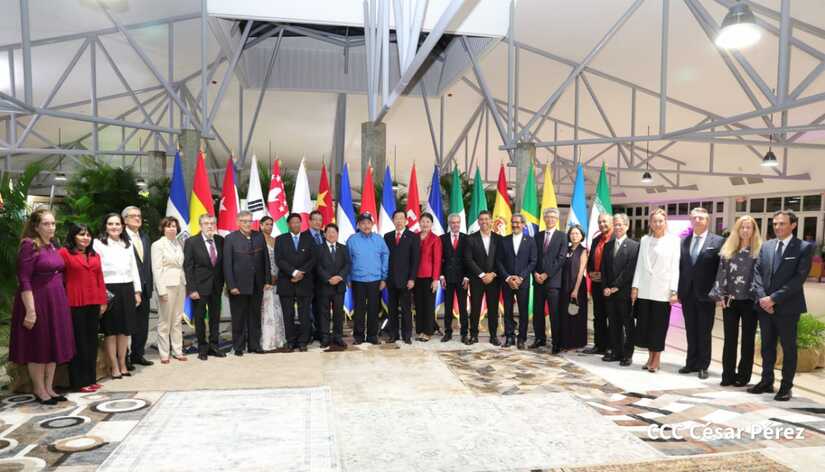
At the start of every year we commemorate Darío, Rubén Darío, who was born on January 18th, 1867, and we agreed, we decided, to receive these Credentials today, February 6th which is the date on which he left this plane of Life and departed to another plane of Life, there in the City of León.
Reading Darío is to read fragments, thoughts, reflections turned into prose, into poetry, in which I'd argue that he covered all cultures, that is to say, he did not limit himself to Latin America, but went beyond, and traveled, via his knowledge, via his culture, via his writings, he traveled the China Sea, he traveled the Arab Countries, he traveled Europe, he traveled burning hot Africa.
In other words, no region of the World, or People of the World is absent from Darío's literature, in which he was always fighting for Peace. His last calls for Peace were uttered when he was already on his way back to Nicaragua, and he, observing the war, always fought for Peace, demanded Peace.
He was an extraordinary Being who, from a very humble origin, very humble, without going to grand schools, without going to university, even so, he brought magic, genius, he carried it in his Soul and the words came to him, and such that when Darío started writing they dubbed him there in his village, “the Child Poet".
No one imagined back then that a Nicaraguan, a boy of humble origin, would later travel a good part of the world, travel it physically, but that above all he would travel the whole world, because he did travel it, with his deep thought, with his prose, with his writings, always advocating Peace when acting as an emissary of Nicaragua in various countries, because he was also, by the way, an Ambassador, he was delegated at different times to various countries, in Latin America, in Europe.
However he did not limit his work to diplomacy, but went beyond that, always writing, writing for newspapers too, he practiced journalism, and as a journalist clearly felt bound to call for Peace. So Darío's writings in that respect are still valid, and Darío's struggle for Peace is still valid, today more than ever, today more than ever!
Here I have these notes, that as a young man, a boy, Darío, in 1892, on the Fourth Centenary of the arrival of the Spanish to the Americas he was appointed as Secretary of the Nicaraguan Delegation to Spain, from June to December 1892. Dario was there in Spain.
Then, in April 1893 he spent 2 years as Consul General of Colombia based in Buenos Aires, he was covering Argentina, and Darío's chronicles are well known in Argentine newspapers.
On March 12th 1903, he was appointed Nicaragua's Consul in Paris, President José Santos Zelaya appointed him, and one see's how Darío reacted later because he could not understand, could not accept that the United States rulers of the time had decided to overthrow President Zelaya, simply because he had promoted a revolution in Nicaragua, a Liberal revolution.
That is where those situations occur that result in an outrage to the rule of Law, an outrage to the world's Peoples, because just when one is crushed, all are exposed to abuse.
Because President Zelaya received a note from the United States Secretary of State, Philander Knox, which became known as the Knox Note, in which he was told that they were giving him just hours to leave the country, because US troops were already on their way to Nicaragua. And Darío was unarguably irritated at this insolence, at this act of arrogance.
So you, a Foreign Minister, because he belonged to a Great Power, simply sent a note, and the country's President had to comply, and did comply. But there were Liberal party generals who rebelled against the Knox note, and then the fighting began here with US troops invading Nicaragua.
Later, he was appointed to represent Nicaragua at the Inter-American Conference in Rio de Janeiro, in Brazil.
On December 27th 1907, before President Zelaya was overthrown, he had been appointed as Resident Minister in Madrid, Spain, where he presented his credentials on June 2nd 1908; and then the disaster of the Knox Note took place.
Before that happened, in 1910 he was appointed Minister Plenipotentiary of Nicaragua to attend the Great Commemoration of Mexico City, he was invited; and also, on September 6th 1912 he was appointed Consul of Paraguay. That is, Darío also had a diplomatic career, which did not prevent him from continuing to revolutionize literature and did not prevent him from continuing to write the denunciations that he felt bound to make at the time as a journalist.
An extraordinary Being that Nicaragua loves, as her own! Nicaragua has two Heroes, among so many Heroes, two Heroes who stand out for their universality: Darío and Sandino.
Darío died on a day like today, February 6th, and Sandino was murdered in the month of February, on February 21st, but they are always present in the Soul, in the Heart, in the Identity of Nicaragua's Being.
Darío had enormous sensitivity, in that so much he wrote on the Dignity of the Human Being, on what Dignity is, on what shame is, on the terrible thing of being subject to slavery, domination, impotence, impotence!
You just have to consider everyone Dario wrote about? In the United States that he questioned so much; well, he wrote to Walt Whitman among others. And how much he praised the heroism of our indigenous roots, there is that famous one that is very popular here in Nicaragua, dedicated it to the Chilean indigenous hero, “Caupolican”, which reflects the burden, the pain, the suffering of the Chilean indigenous peoples, of the Latin American and Caribbean indigenous peoples.
And so many Poems, to Antonio Machado, to Verlaine. He had an amazing culture! Later on, writing “The Rabbi's Head”, "A Sonnet to Cervantes”, "Litanies of Our Knight Don Quixote". And there is a also poem he wrote that refers to bullfighting, how much controversy there is over bullfighting! But well, we have native bullfights here.
I was born in a village where as a boy we used to take part in bullfighting, riding young cattle and horses, there in Chontales. Then I had no idea of the big-time bullfighting that existed in Mexico and also in Spain, and I could not think of anything but enjoyment when I saw bullfighting; it was an amusement, a distraction for the people, for the peasant families.
But Darío saw beyond that and wrote the extraordinary poem called "The Deed of the Bullring". I'm not going to read it because the poem is quite long, but I'm going to describe how Darío uses, on the one hand, the following characters: the Bull, the Ox, and the Crowd, who are the ones who are there at the bullring.
What is the name of the oldest bulling you have there in Madrid? I was there one, a very old, rather small place, the "Plaza de las Ventas", and I enjoyed the presentation, but although I enjoyed the presentation I also remembered Darío's Poem of the "The Deed of the Bullring". You see, it has the crowd at the bullring, shouting: Another bull! Another bull! The excited crowd wanting another bull.
And there is the Bull and there is the Ox, they are close, because the oxen are used later to drag away, remove the bulls that have already been killed by the sword, so then the oxen drag the bulls away, that is, the oxen are not in any danger, the oxen are there calmly, it is supposed, and they do no more than wait for the bull to be killed to then drag it away.
So then, as people are shouting: Another bull! Another bull!, the Ox asks the Bull, or the Ox says to the Bull: "Have you heard? Prepare your thrust, your horns and hide; your turn has come. Wild anger, flags and pikes that harass you, applause for your executioner..." of course, the bullfighter receives the applause, because almost always the bullfighter is the winner, and the Bull adds: “Finally, death and beyond, the impassive, lonely contemplation of the vast firmament.”
And the Ox says, the Ox is saying to the Bull: "I, ridiculous and mean, am the patient one...”. That is, the Ox does not feel happy because he is not going to die, but says: “I, ridiculous and mean, am the patient slave. I am the humiliated eunuch...”
And there the Ox goes on talking, complaining, and says at the end: If I suffer the blow and the goad, I reflect...”, because they are jabbing the oxen to make them walk, so he says:
"If I suffer the blow and the goad, I reflect that God grants me the right...”. What right, says the poor Ox, does God grant him? "To scare the flies away with my tail.” Meaning, he's an Ox that's sore, humiliated.
Then the Bull talks about when he was roaming the vibrant pampa and that now they have him there, and they are both there exchanging, discussing, until the Ox reminds the Bull that he also walked the pampa but that he has now been castrated and lost all the brilliance that the Bull has. That is, the Ox tells him, I was a star too, but you are still whole and that is why you are here and that is why you go out to face death.
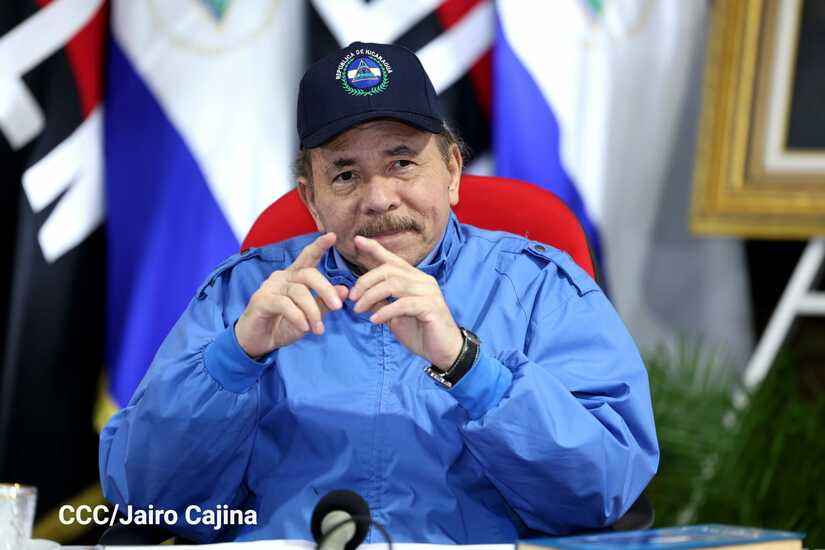
Then, at the end of their long conversation, the audience is still shouting: Another bull! Another bull! And now only he is left, the Bull who is talking to the Ox. Then the Ox says to him, because after all the time the bull had spoken to the ox at length, talking about everything to do with his strength, with his life; then the Ox says to him: “Hush! Die! It's your time” " Because they're already whistling for him, they're already calling him.
And the Bull then says to him“ "An ntrocious sentence! Yesterday the air, the sun; today, the executioner... What's worse than this martyrdom?", says the Bull to the Ox. And the ox replies, "Impotence." And the Bull says to him: "And what is blacker than death?”, because he knows he is going to die and the Ox is going to live. And the Ox replies, "The yoke!”.
How much wisdom, how much sensitivity, on the part of Darío, and this can of course be applied to humanity, humanity that has lived under the yoke like slaves, and humanity that has had to fight to break the chains.
I wanted to share with you this poem, which is one of the poems by Darío that I most admire, and to share with you, beloved sister and brother diplomats, the poems of someone who was also a diplomat. And to tell you that we welcome you to Nicaragua and that we have the best will to bring our relations closer and seek points of agreement. That is easily said, it is always said, that you have to look for the points of understanding and put aside the differences so as then to be able to move forward.
How much has it cost the fraternal Colombian People to fight for peace! How much has it cost you! So many efforts for peace! And with the victory of President Petro, an opportunity now opens up, but still amid a situation of pain, of death, which is not stopped, where the challenge is enormous in order to achieve peace.
I had the opportunity to be in one of those peace attempts, in San Vicente del Caguán, I was invited by Comandante Marulanda, I was also invited by the Government of Colombia, the President who at that time was making the effort for peace. The meeting was held there in the mountains, near the FARC encampments, and it was a meeting that created a lot of expectation. It seemed that peace was coming.
They exchanged views, there were many international guests as possible guarantors of the Agreements that might be signed, but in the end the war was stirred up again. Because it was not only the guerrillas demanding peoples rights, but also the Army was organized and paramilitary forces were organized in a way that multiplied crimes.
Stories are now emerging there. I was watching on Colombian television just now, before coming here, the admissions made by a Colombian army Colonel and a General, and how they related that they were used by the Army to assassinate peasants who were relatives of guerrillas and therefore supposed to be FARC supporters, and how afterwards they made them look like guerrillas killed in combat. What became known as the false positives there.
What is described there is striking, everything those took part are talking about, he himself participated and is implicating the Army Chiefs who participated; that is, a truly terrible, painful situation.
However, even though the situation remains complex and difficult, there are good signs for Peace, and there is a climate in Latin America and the Caribbean, beyond the ideological and political differences that we have, the meeting point that is CELAC.
For the first time in history that we have a meeting point of our own, of Latin Americans and the Caribbean, and by joining forces in every way to achieve Peace, to defend Peace, I am sure that we will live up to that principle we subscribed to at the CELAC meeting in Havana, declaring Latin America and the Caribbean a Zone of Peace, a Zone of Peace!
Of course, it is not easy, but it is a very big step for all Latin American and Caribbean Countries to be committed to Peace. And commiting ourselves to peace so that we can achieve not only an end to brutal acts of violence, such as those happening in Colombia, such as those happening in Mexico, victims of drug trafficking and organized crime that has the large market in the United States of America.
If there were no market, there simply would be no reason for drug traffickers to exist or organize, because the big market is in the North, in our region the markets are small, for them are like corner stores. They are looking for the big market in the North, in the United States, in Canada, in Europe, where they pay very well for drugs, and where, involved in these crimes, in these offenses, are authorities of all kinds, from those who are in customs to those who are in high positions in police departments, in the neighborhoods of the United States, such that the drugs can circulate, and from there also come the weapons to arm the drug traffickers.
This is a huge challenge that we have, the fight against drug trafficking, against organized crime, but we also have to be demanding of developed countries, they have enough resources, enough capacity to control drug trafficking, to end drug trafficking.
Ah, but they want the countries that are victims of this trade to put an end to drug trafficking; they are indeed victims, because every day the drug traffickers fighting to dominate the market and transfer this product to the United States, to Europe, confront each other and murder innocent people. This is a disease here in the region and I would say that it is a fundamental issue in the struggle for Peace.
Beloved Ambassadors of Peoples, of sister and brother Nations, we are all sisters and brothers, even if we get along badly, but we are indeed brothers and sister, we are from the same family even if we quarrel from time to time, that is the truth. The important thing is that we are able to understand each other, to respect each other.
If at the United Nations the Organization does nothing in order to respect the United Nations' Principles and Norms, because it is an Organization that is simply for spending money. We, the Latin American and Caribbean peoples united in CELAC, can do a lot to put an end to these evils.
We have the solution and we cannot just wait for the governments of countries that are big consumers of drugs to come along and solve the problem for us. We are the ones who have the solution, with firmness, with unity, with respect, which is the disposition Nicaragua has towards all the countries of the world: To work together for Peace.
We could go on talking about other terrible, painful issues, organ trafficking, child trafficking, criminal violence against women. These all must disappear, and together all of us can perfectly well, in a short time, reduce this violence.
Here you have a People who have fought for peace, who continue to fight for Peace, a People with open arms. In all the communities, in all the regions that you visit, in all the places that you visit, you will find Families who will receive you with Joy, with Affection and with Love.
Thank you very much, beloved Ambassadors.