
Roger D. Harris and John Perry, September 22nd 2026
Media treatment of leftist Latina leaders in Venezuela, Nicaragua, and Mexico
Women who attain political power are often judged by the US-aligned corporate press not simply by what they do but by how politically acceptable they are. This is evident in the strikingly different media treatment of three Latin American leaders, all lifelong leftists, raising the question of how relations with the US shape media judgments of political legitimacy.
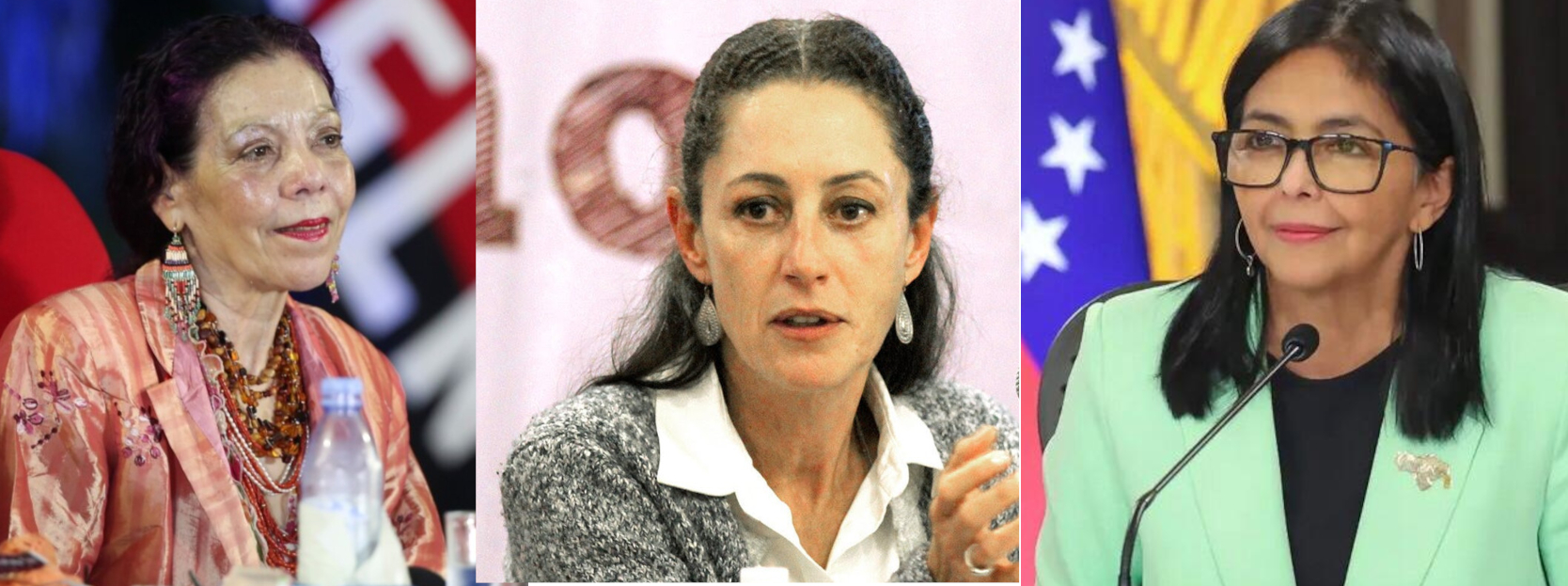
(L to R) Rosario Murillo, Claudia Sheinbaum, Delcy Rodriguez
Venezuela’s Delcy Rodríguez
The Guardian’s profile of Venezuela’s Acting President Delcy Rodríguez acknowledges that she is a “pragmatic, witty and intelligent workaholic” who worked her way up the ranks. But the take-home message of the hatchet-job by author Tom Phillips is that she is a “belligerent, power-hungry chameleon…responsible for Venezuela’s slide into poverty and dictatorship.”
He reminds us that Rodríguez is “unelected,” conveniently omitting the fact that after Venezuela’s elected president was illegally abducted by the US, she was vice president and constitutionally sworn in as acting head of state. Jorge Rodríguez, her brother, is reported to have “established himself” as head of the National Assembly, obscuring the fact that he was elected.
While posturing as a defender of democracy, Phillips goes on to say that the lawful president “was widely expected to be replaced with María Corina Machado.” “Replaced” through military invasion is not exactly a democratic process, while his phrase “widely expected” reflects the expectations of the US-aligned press, not those of the Venezuelan people.
Yet corporate media outlets calling for “free elections” largely ignore the contradiction inherent in abducting a sitting president while promoting Machado as the democratic alternative. Machado, who begged Trump to sanction Venezuela and Netanyahu to bomb it, now finds her extreme-right corner of the opposition discredited and in disarray. Imagine a Brit, comfortably living abroad during the blitzkrieg of London, urging a foreign power to keep attacking her own country.
To its credit, the Wall Street Journal reports that Rodríguez “has told Washington that while she supports holding elections eventually, the US should unwind the sprawling set of sanctions on Venezuela so revenue flows can resume and repairs can be made to battered infrastructure before a vote is held.” In other words, as long as Venezuela is being blackmailed by US sanctions, truly “free and fair” elections are impossible. Phillips ignores the fact that these sanctions throttled the economy when he says Delcy Rodríguez “enjoyed a rapid ascent” while “her country nosedived into hunger and authoritarianism.”
The center-right WSJ’s description of the once “hardline socialist” is less harsh, because it portrays her as having moderated her former leftism. However, historian Steve Ellner argues that Rodríguez has not betrayed the revolution but has adopted Deng Xiaoping’s dictum: “hide your strength, bide your time.” Venezuelan writer José Amesty Rivera argues that if she had followed any other course of action, the outcome could have been widespread civil breakdown, leaving the country ungovernable.
Nicaragua’s Rosario Murillo
Media profiles of Nicaraguan Co-President Rosario Murillo are strikingly personalized and frequently hostile. They overwhelmingly emphasize her personal power but pay little attention to her political ideas, her social constituency, or how her supporters understand her role.
Nicaragua is unique in having a “co-presidency,” created via a constitutional reform in February 2025, which threw a new spotlight on Rosario Murillo, Daniel Ortega’s wife. For the Miami Herald, she is Ortega’s “partner in crime,” for the BBC his “extravagant wife” and for The New York Times and LA Times “the real power behind his presidency.”
Media coverage of Murillo is particularly personalized and gendered. The Guardian and CBS News label her as “eccentric” to justify their frequent ad hominem attacks. For El País, she is the “grotesque wife” of the “toxic couple.” Earlier, she was a cunning “Jezebel” living in an “esoteric universe.” The Guardian called her “an eccentric and widely reviled poet.”
The media ignore the real backstory to the “co-presidency,” which is the extraordinary rise of Nicaraguan women to positions of authority. Women are guaranteed at least 50% representation at all levels of government and hold more than half of ministerial posts. According to the World Economic Forum, in 2024 Nicaragua ranked sixth globally for overall gender equality, and third for female parliamentary representation. These achievements, which Murillo and Daniel Ortega jointly promoted, were accomplished in under two decades.
But rather than acknowledging Nicaragua’s gender equity as a source of democratic legitimacy, the Miami Herald contends that “Nicaragua’s first lady is nothing to celebrate: She’s a step backward for women.” Deriding Nicaragua’s achievement, it says that “gender representation in authoritarian governments is rarely a reflection of genuine progress. It’s part of a broader strategy to cling to power.”
The media’s “power behind the throne” narrative undervalues Murillo’s dynamic role in government as effectively the country’s prime minister, overseeing its ministries and ensuring that they meet targets and respond quickly to crises. Not only has this secured real social advances in Nicaragua – the country has had the region’s fastest growth in GDP over the past decade, has the largest hospital network, the best roads, and free education through university level – but also enabled the government to respond effectively to emergencies, such as two violent hurricanes.
Women, in particular, have benefited from free health care and innovative programs such as 182 casas maternas – where rural women and those with high-risk pregnancies wait to give birth. Maternal mortality fell by 67.7% and child mortality by 58.6% in just 17 years.
Contrary to these media profiles of Rosario Murillo, most Nicaraguans recognize her real achievements, often referring to her familiarly as La Compañera.
Mexico’s Claudia Sheinbaum
Mexico’s Claudia Sheinbaum offers a brief counterexample to the other two profiled leaders. All three women come from the left, but the US relationship with Mexico differs from its relationships with Venezuela and Nicaragua, if still part of its explicit posture of dominating its hemispheric neighbors.
Sheinbaum is hardly less powerful, but unlike Rodríguez and Murillo, she does not represent an explicitly socialist political project. Consequently, the recurring media narrative surrounding her is one of pragmatism, diplomatic skill, and independence rather than the personal ambition, eccentricity, and authoritarianism that dominate profiles of the other two women.
Before Sheinbaum’s election, the media buzz focused on whether she could escape her male predecessor’s “shadow.” Once in office, the narrative changed markedly. The Washington Post portrayed Mexico’s presidenta as taking on Trump. The Los Angeles Times dubbed her a possible “Trump whisperer” and later described how “firmness, flattery and phone calls” enabled her to win over the US president. Time characterized her handling of Washington as “a lesson in diplomacy.” The Guardian, having earlier questioned her independence from her predecessor, now calls her “the world’s most popular leftwing leader.”
Gendered tropes follow from Washington’s political hostility
Venezuela’s Bolivarian Revolution and Nicaragua’s Sandinista Revolution strive for socialism, making them targets for regime change. Both have been subjected to coup attempts, diplomatic isolation, and punishing sanctions. The pressure has been more intense on Caracas, but Rubio promises more for Managua. Meanwhile, for the explicitly capitalist Mexico, despite constant threats of military intervention on the pretext of combating drugs cartels, regime change need not be Washington’s endgame.
Gender and leftist credentials alone do not determine how these women are portrayed by corporate media. The issue is not simply whether powerful women are treated differently from powerful men. Rather, gendered tropes become especially useful when a woman exercising power represents a political project that Washington considers hostile.
Sheinbaum governs a country closely integrated commercially and financially with the US and able, for the moment, to maintain a tense but workable relationship with Washington. Rodríguez has been forced to make difficult choices while subjected to relentless US extortion under threat of devastating military aggression. Murillo represents a government insisting on Nicaragua’s sovereignty despite menacing US government declarations of more intense coercive measures. The dividing line in these media profiles appears to be less women in power than which women – and which political projects – are considered acceptable in power.
US-based Roger D. Harris is active with the Venezuela Solidarity Network. Nicaragua-based John Perry is active with the Nicaragua Solidarity Coalition. Both are on the board of the 41-year-old human rights group, Task Force on the Americas.