Stephen Sefton, Tortilla con Sal, May 25th 2020
Competing views on how best to combat the SARS-CoV-2 virus have exposed more clearly than ever how medical science and science in general is as much riven by partisan prejudice and unfair bias as any other human activity. That is even more so in the case of intellectual production in the social sciences. Failings of intellectual integrity abound, all too frequently reproducing false reporting of events by news media. The most common faults include failure to check basic facts, refusal to engage contradictory versions of events, selective use of sources, and the charade of corroborating accounts only with sources ideologically aligned with the original source. With regard to academic reporting on foreign affairs, such failings are so common as to practically constitute the norm.
The violent failed coup attempt by Nicaragua's opposition between April 18th and July 17th 2018 has produced a plethora of material reflecting this reality. Even moderately flawed academic accounts by apparently well-intentioned liberal academics often present research and argument that ultimately reinforce extremely sinister right wing ideological and political agendas. Catherine Stanford's "Nicaragua and Agamben’s State of Exception: Misunderstood History and Current Crisis" is representative in this sense. While multiple errors and misrepresentations figure in her account of the crisis in Nicaragua 2018 and the related historical context, a look at just a few is enough to explain why her account can reasonably be considered to be flawed.
Firstly, in her account of "the human rights frame" she asserts that "Civil society groups initiated a National Dialogue" in April 2018, which is completely untrue. As President Ortega made clear in his address of April 21st 2018 his government never abandoned its commitment to dialogue, despite the private business sector walking out of talks about social security reform earlier that month. It was President Ortega in that address who broached the idea of a broad national dialogue and, the next day, in his message of April 22nd 2018, proposed that the Bishops' Conference of the Catholic Church mediate any process of dialogue. It took the recalcitrant opposition groups Stanford designates as "civil society groups" over two weeks to finally agree to those talks.
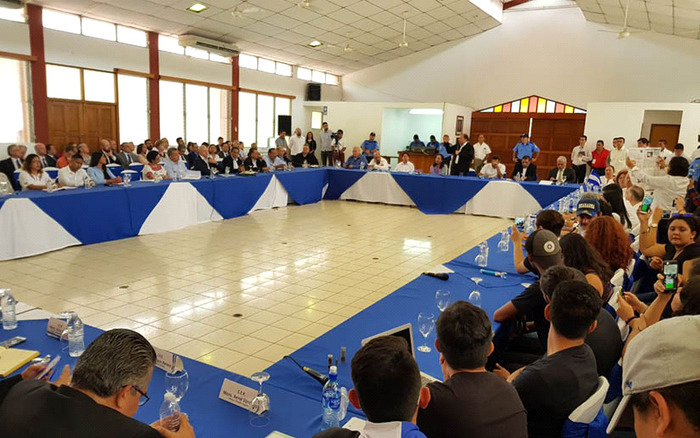
Opening of the National Dialogue in 2018
For their part, the bishops, after initially agreeing to mediate the talks without pre-conditions, eventually insisted on several opposition imposed preconditions, the most serious of which was to withdraw the national police from the streets, to which the government agreed. This decision allowed violent opposition gangs to blockade roads and highways across Nicaragua for the next two months, intimidating, extorting, assaulting and murdering people trying to go about their daily lives. But in order to facilitate the dialogue, the government accepted that situation, which itself caused many sandinistas to organize in self defense against opposition attacks, for which they were dubbed "paramilitaries" by opposition propagandists.
The reality is that Stanford's "civil society groups" resisted engaging in dialogue because above all they wanted regime change, as the opening session of the talks on May 16th made very clear. Furthermore, Stanford's glib use of the term "civil society" ignores the fact that, for example, all the main labor organizations, and almost all Nicaragua's numerous cooperatives and rural workers organizations, supported the government. What Stanford seems to mean by her sloppy use of the term "civil society" in the Nicaraguan context is "opposition aligned students and rural workers, all opposition aligned NGOs and most private business sector organizations".
Secondly, among many other examples of biased use of language, Stanford claims that "National Police ransacked the newsroom of Confidencial in Managua, Nicaragua, stealing computers". In fact, the Nicaraguan authorities deemed that CINCO, the non-governmental organization coupled with the US-funded opposition propaganda outlet Confidencial, both owned and run by Carlos Fernando Chamorro of the oligarchic Chamorro family dynasty, had broken the law relating to the charitable and social activities of non profit organizations. Chamorro refused to cooperate with the authorities.
So, in order to enforce compliance, the police were therefore bound to act as they would anywhere else in the world faced with openly deliberate non-compliance with the law. This incident was a re-run of a very similar incident in 2008 in which Chamorro also provoked the authorities, essentially daring them to take action against him. Back then they chose not to. But in 2018 they did, because Chamorro's US funded opposition propaganda and material support for the political opposition very definitely flagrantly breached the rules governing non-profits in Nicaragua. So the police enforced the law and impounded documents and equipment belonging to CINCO and Confidencial.
Stanford clearly sympathizes with Chamorro and therefore uses the inexcusably loaded word "stealing". A genuinely impartial academic would have used words like "confiscating", "sequestering" or "impounding" which would more truly have reflected what actually happened. By choosing to use the word "stealing", Stanford reinforces the false overall opposition claim that, throughout the crisis of 2018, the police acted illegally, which is a grossly meretricious reversal of the facts.
Among many other noteworthy points, Stanford seems clearly to sympathize with Nicaragua's reactionary Catholic Church bishops observing, "The Catholic bishops tried to keep the National Dialogue going, but they decided that they had to speak out against the continuation of the violence". In fact, the Catholic Bishops very soon after the start of the National Dialogue came to be regarded by the government side as blatantly prejudiced advocates for the regime-change focused opposition. Stanford completely ignores the role of the Vatican and the fact that after the talks broke down in June 2018, Pope Francis felt bound to authorize the Papal Nuncio to Nicaragua, Waldemar Stanislaw Sommertag, to substitute for the local Nicaraguan Bishops as a mediator, which he did successfully.

An opposition roadblock - the failed coup aimed at shutting down the economy to force regime change
Or again, Stanford refers to "a massive national strike" in September. But there was never any national strike participation from the main labor federations or their member unions or the huge cooperative sector or the various social sectors making up Nicaragua's popular economy, almost all of which overwhelmingly supported the government. During 2018 there were indeed various abortive attempts at a lock-out by the private business sector which contributes about 20% of Nicaragua's total work force. There was never a massive national strike in 2018.
These few examples give some sense of the failings and bias apparent in Stanford's account. A more general point is her very selective use of sources. Although she cites over 120 references, just six can be considered to sympathize with the government. Stanford chose to exclude the opinions of leading non-Sandinista critics of the opposition like the journalists Adolfo Pastrán or Moises Absalón Pastora. She also excludes references to extremely valuable and highly relevant sources exposing opposition falsehoods like the reports of Dick and Miriam Emanuelsson, of John Perry, or similar material at Tortilla con Sal. Nor does she reference the testimony of former Amnesty International Prisoner of Conscience Camilo Mejía or the widely published work of Dan Kovalik and Brian Willson, both of whom are lawyers, as well as being extremely influential and credible voices in defense of human rights.
Apart from that clear exclusion of sources sympathetic to the Nicaraguan government, also worth noting, given Stanford's insistence on the theme of human rights, is the absence of any reference to notorious opposition crimes like the attempted murder of student leader Leonel Morales, the massacre of police officers in Morrito, the murderous arson attack on Nueva Radio Ya, the murder of Bismarck Martinez, the torture in a Catholic Church of Sander Bonilla, the torture, murder and burning of police official Gabriel Vado Ruiz, the burning of other murdered sandinistas, or the fact that 22 police officers were killed and 400 suffered gunshot wounds as a result of opposition attacks.
Any impartial academic account might be expected at the very least to mention these events, although Stanford does mention the independent report "Dismissing the Truth" which challenges very credibly the version of events given by Amnesty International, and therefore too, implicitly, the false reports of the respective OAS and UN human rights bodies. Even so, anyone not familiar with Nicaragua reading Stanford's essay will finish it still believing that Nicaragua's Sandinista government can reasonably be viewed as an exceptionally authoritarian regime with little popular support, whose police indiscriminately murdered peaceful protesters in 2018 and has since continued to suppress freedom of expression. All of which is demonstrably untrue.