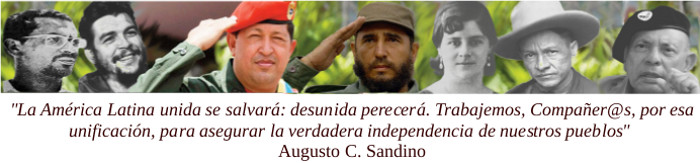
Jorge Capelán, Managua con Amor, 4 June 2019
https://managuaconamor.blogspot.com/2019/06/el-pueblo-sandinista-y-su-a…
 To many it may seem a lack of modesty, but it is a reality. The Sandinista Popular Revolution has made invaluable contributions to the peoples of the world. At the end of the 1970s, it triumphed at the most difficult moment for the Latin American Left and, in the 1980s, it became a beacon and focus of the struggle of the peoples oppressed by imperialism worldwide.
The innovations it brought at that time, such as the recognition of the role of Christians and advocacy of the basic rinciples of a mixed economy, political pluralism, social justice and anti-imperialism, or the issue of the autonomy of indigenous peoples, have today become indispensable ingredients of teh 21st Century revolutions in Our Americas.
It is impossible to imagine the Bolivarian Revolution, Bolivia's Indigenous Anticolonialist Revolution, Ecuador's the currently betrayed Citizen's Revolution, or any other of the processes of those taking place in Abya Yala as anything but in great measure an extended dialogue with the questions posed in their time by Nicaragua's Sandinistas. This is also the case for Cuba, currently undergoing a process of generational change and, like all of us, facing the difficult readjustment to a nascent multipolar world order.

Photo: The Voice of Sandinismo
It is true that the Sandinista Popular Revolution cannot be copied. In 1979, at a single stroke, by means of an armed struggle that cost thousands of deaths, it destroyed a somocista state tailored to the needs of the United States in the Central American region. What followed is pretty much common knowledge: Another bloody counterrevolutionary war along with profound property reforms, the cultural insurrection of the National Literacy Campaign, the process of approving a new Constitution with the people as the protagonists and then the bitter political defeat of the 1990 elections. There followed the neo-liberal counterrevolution, 16-years of resistance, and a highly successful return to power to resume the interrupted tasks of the Revolution in the light of long experience.
It is a very hard story, one that has cost a lot of blood and suffering. Decades and generations of what to paraphrase ComandanteTomás Borge could be described as "patient impatience," that capacity to wait for the right moment without forgetting, and without wasting the least opportunity, that only peoples like ours, who during 500 years or more of oppression have known how to survive so many times and in so many ways, only peoples who have gone through so much bitterness without losing hope and faith, are capable of demonstrating.
Although historical experiences are unrepeatable, for the peoples of the capitalist "periphery" lacking great natural sources of income extraction, like oil or other highly "monetizable" resources, and who thus cannot count on inexhaustible resources of economic subsidy, for these peoples the Sandinista experience contains many contributions of enormous value.
In the current conditions of subjugation imposed on the peoples of the world, these contributions consist in empowering the available resources so that these peoples manage to change the correlation of forces and achieve tangible results overcoming poverty. Obviously, the task cannot be carried out without international solidarity and alliances, but the existing room for manoeuvre is much wider than one would think if one takes a broad view of reality based on a deep knowledge of one's own history.

The Sandinista Popular Revolution also has current lessons for other countries, since neoliberalism by making formal employment a privilege, has caused the so-called "informal sector" of the economy to expand everywhere like wildfire. The experience of Sandinista Nicaragua shows that it is possible for grass roots sectors to become true economic as well as social and political protagonists. No one shoudl see these sectors as natural allies of imperialism or as "petty-bourgeois" leftovers.
The Sandinista Popular Revolution today raises issues such as the need for agrarian and urban reforms (issues largely forgotten or left untouched by the Left), the problem of property titling, the problem of food sovereignty and also the question of respect for the cultural roots of our peoples.
These experiences are embodied in the Sandinista people, who represent a vast social sector of the country. It is so large and well-organized that it has assumed a leadership role for the rest of society. Without any doubt, organized Sandinismo is the largest and most successful socio-political movement in Nicaragua. Armed with this heritage, the Sandinista people managed last year to defeat the attempted "soft coup" attempt that sought to destroy Sandinismo and with it the Nicaraguan nation.

Commander Daniel Ortega and Commander Raúl Venerio
Last Sunday, June 2, saw teh death of 74-year-old Comandante Raúl Venerio Granera, a historic guerrilla fighter, one of the leaders of the insurrection in the capital Managua and the first commander of the Sandinista Air Force. A large crowd of Sandinistas came to bid him farewell yesterday in Managua. Comandante Venerio was, in addition to being a very well known Sandinista militant, the national coordinator of the movement of Sandinista historic veterans, who during the "soft coup" played a very important role transmitting their experiences of struggle to a new generation of Sandinistas who, after 11 years of a necessary alliance with sectors of the bourgeoisie, had lost the traditions of conspiracy against all odds of previous historical Sandinista generations.
What is often ignored outside Nicaragua is that the Sandinista Front is a revolutionary party of the masses that spans several generations and that has defended revolutionary struggle for many decades. It therefore retains an extraordinary wealth of experience. In reality, the Sandinista people, organized in the FSLN, is the optimal expression of all the Nicaraguan people.
"We are travelers, we go forward, we are unyielding in our decision to win and ensure the best possible life for Nicaragua's people, that is the historical commitment of Sandinismo, of Sandinistas, that is what we live for and that is why so many people, women, men and even children have given their lives in this free homeland that we honor every day by raising these flags," said Vice President Rosario Murillo this Monday during the posthumous tribute to Commander Venerio.
As regards those ex-Sandinists who abandoned the struggle and drifted towards the worst of the ultra-right, she said, "Faced with that tiny group of people current day traitors, there has risen up the gigantic will, presence and decision of a people willing to forge more and better victories. Raúl (Venerio) has left us in the very days when we begin to commemorate our heroes, the people they tried to kill and couldn't, because all were committed to these roads to victory for their families, mothers, sisters and brothers, children, grandchildren, for them, for all of them, the commitment is to win, the indispensable and irreplaceable commitment to win".
 "We are a brave people, the people of Sandino, of (Rubén) Darío, we do not sell ourselves, we never surrender, we don't know how to give in, or how to bend, we know how to keep going, to advance, to transcend, to confront trials, threats and challenges. We know about life, that life is many things, we do not denyit, on the contrary, we embrace it with all its potential and riches, the life that commands us, in the sacred name of the Nicaraguan people, to conquer and always go forward for more and many new victories of faith, hope, new victories by the hand of God," she emphasized.
For his part, President Comandante Daniel Ortega assured that "We say to Raúl: Here is your people, here is your family, here is your Nicaragua. And we will all continue raising the red and black flag that General Sandino raised so as to continue defending the blue and white flag of Nicaragua dragged through the mud. Throughout our history, the blue and white flag has been dragged own and handed over to "the fierce barbarians", as Rubén Darío called them, and then finally, yes, liberated on July 19, 1979 by the decision of the people, by the strength of the people, accompanied by God, by Christ. Where the people entered in triumph on July 19th, there was Raúl Venerio".
Presidente Daniel Ortega condecora póstumamente al Comandante Raúl Venerio
Comandante Daniel Ortega affirmed that "it is the hands of the historic combatants that place this medal (referring to the award of the Order of General Augusto C. Sandino) on the chest of Raúl's mother, of Raúl's daughters, of Raúl's granddaughter. It is the people of Nicaragua who are awarding that Order. May Comandante Raúl Venerio live forever. Sandino lives on, the Struggle Continues. Free Homeland or Death".
Comrade Leopoldo Ríos, a militant historic Sandinista fighter, confirmed the loyalty of the Sandinista fighters to the revolutionary process under the leadership of President Daniel and Compañera Rosario:
"Today the historical Sandinista combatants represent the Nicaraguan families fighting for their conquests, for their demands and we say farewell to a beloved son of that Sandinista family, who sacrificed his life as did many others for a better homeland, today we say farewell to Raúl, but we not to our homeland, nor to our struggle, we acknowledge his passing to another plane of life but thousands more have arisen willing to defend the Revolution," said Leopoldo.
With this Sandinista people, the continuity of the Revolution is guaranteed, not only for the good of the Nicaraguan people, but also for the good of all the peoples of the world.