Francisco Dominguez, December 22nd 2018
The real issue in Nicaragua is Trump’s ‘regime change’ agenda: a response to "Nicaragua - Jeremy Corbyn must end his silence over the country’s repressive regime"
Jeremy Corbyn has been a long-term supporter of progressive governments in Latin America. But Hilary Francis has called in The Conversation for him to ‘end his silence’
and condemn what she calls Daniel Ortega’s ‘repressive regime’

Photo of armed anti-government protestors, published in the The Guardian (11th June 2018) originally by Oswaldo Rivas/Reuters.
It is clear that Hilary Francis does not support the democratically elected government of Nicaragua. She has penned a number of pieces where she has made this abundantly clear. This is entirely within her right. Despite the 72% Daniel Ortega obtained in his re-election in 2016, not everyone supports him in Nicaragua, and his government has ferocious enemies particularly in the US Republican Extreme Right, who since the FSLN came back to office in 2006 have made it explicit that they wish to oust the Ortega government.
What is problematical in Ms Francis’ piece is to (a) distort the facts of the situation to suit a particular narrative (b) and, this narrative being an argument in favour of violent ‘regime change’ in Nicaragua. My contention is that Ms Francis’ piece (and similar recent articles on Nicaragua) seeks to demonise the democratically elected government of Nicaragua as well as denouncing individuals in the British Labour Movement so as to erode support for Nicaragua’s right to self-determination. The end result is inevitably to help facilitate external aggression against the second poorest country in the Americas.
I believe the first is a dereliction of academic duty, but the second is much more serious since it expresses an intellectual commitment to an undemocratic objective, namely, the ousting of the democratically elected government in Nicaragua both by unconstitutional means and by support for US external aggression. It cannot be denied by an objective observer that this was exactly what Ortega’s opponents intended in the uprising of April-July this year.
Ms Francis presents a skewed view of the events surrounding the outbreak of violence in Nicaragua since 19 April 2018 after the government announced the reform of the country’s social security system. The demonstrators’ demand was for the government to withdraw the proposed reform which the government did three days after. The response of the demonstrations’ organisers was not to stop their actions and use this opening to perhaps get the government to agree to amendments to the reform or to abandon it altogether. Instead they ignored the government’s offer and demanded that it resign.
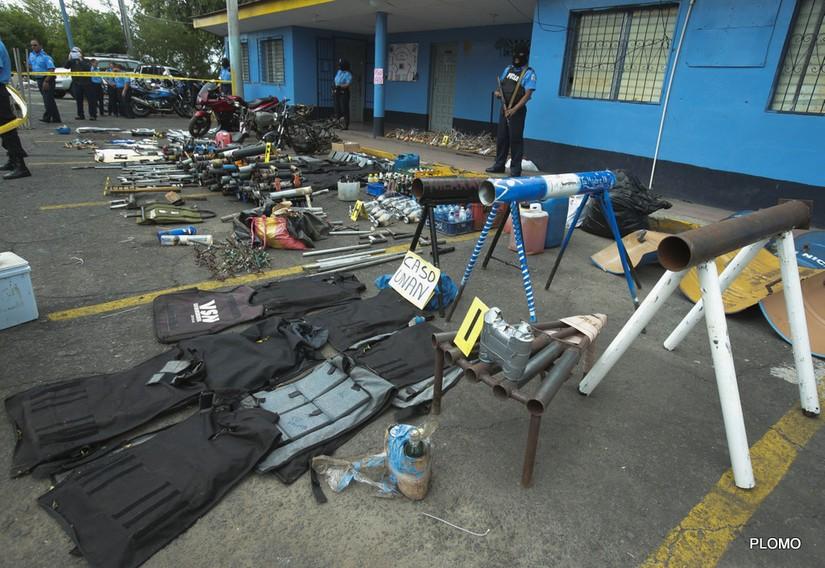
Small sample of seized weaponry of the ‘peaceful’ demonstrators in Nicaragua during the coup attempt between April and July 2018 –
Source: https://www.el19digital.com/articulos/ver/titulo:79097-presentan-a-terr…
This was followed by three months of wanton violence during which ambulances were attacked, hospitals became targets, ‘tranques’ (roadblocks) were set up in a large number of neighbourhoods guarded by armed civilians that terrorised the local population, a period during which being a Sandinista or Sandinista sympathiser made people a target of their violence, when many Sandinista sympathisers were kidnapped, tortured, assassinated, and the bodies of several of them burned in public.
Even worse the perpetrators filmed these gross acts and published them in websites videos and photos that were widely circulated (I have copies of most of them which I can make available on request). In other words, not only there is irrefutable evidence of the use of wanton extreme right-wing violence largely against ordinary civilians, but also that (a) the leadership of the wave of violence made it explicit that their aim was the overthrow of the democratically elected government of Nicaragua, (b) the violence they perpetrated was/is functional to this cherished objective and (c) US destabilization agencies and US funding were crucial in the preparations and deployment of a subversive movement to be the ‘boots on the ground’ for the coup attempt.
If one takes the view that it is all down to the nature of the FSLN government, it is a mystery to explain 12 years of political normality which were suddenly interrupted by opposition to a set of relatively modest economic reforms that the government withdrew barely three days after the demonstrations began. The previous 12 years were characterised by Nicaragua
+ having the second highest economic growth rates and most stable economy in Central America.
+ being the only country in the region producing 90% of the food it consumes.
+ poverty and extreme poverty being halved; Nicaragua was the country with the greatest reduction of extreme poverty.
+ reaching the UN Millennium Development Goal of cutting malnutrition by half.
+ having free basic healthcare and education.
+ illiteracy being virtually eliminated, down from 36% in 2006.
+ enjoying average economic growth of 5.2% for the past 5 years (IMF and the World Bank).
+ becoming the safest country in Central America (UN Development Program) with one of the lowest crime rates in Latin America.
+ having the highest level of gender equality in the Americas (World Economic Forum Global Gender Gap Report 2017).
+ not contributing to the migrant exodus to the US, unlike neighbouring Honduras, El Salvador, and Guatemala.
+ unlike its neighbours, keeping out the drug cartels and pioneering community policing.
The only explanation as to why Nicaragua exploded almost into a civil war was U.S. interference and deliberate destabilisation plans to create the conditions for ‘regime change’. This has been the explicit policy of the Republican extreme right wing that became official policy with Donald Trump (see an informative NSCAG Briefing from July 2018)
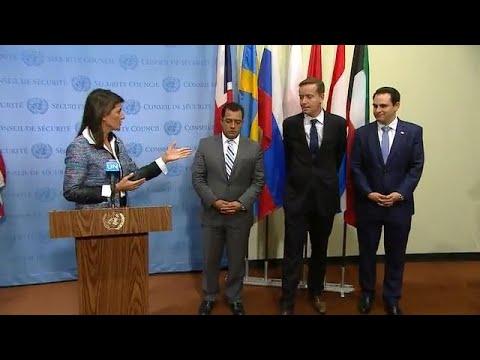
Felix Maradiaga jointly campaigning for ‘regime change in Nicaragua with Nikky Haley, U.S.
UN representative, Gonzalo Koncke, from OAS and extreme Right wing Republican, Cuban-American,
U.S. ambassador to the OAS, Carlos Trujillo; watch the whole event here: https://www.youtube.com/watch?v=rHC8asycMaQ
Human rights reports
Ms Francis quotes, rather unrigorously for an academic, all sorts of figures from various sources without a serious look into them about the number of people who died during the three months of wanton violence. These figures, which have been banded about with a media effect in mind, have fluctuated (depending on who deploys them) from 100 to even more than 500. These numbers have been disputed with forensic detail on many occasions, and many representations have been made to the bodies that have published them, but unlike the more media-oriented human rights reports, these forensic objections have not made it into the mainstream media.
Thus, for example, most people would not be aware that of the total number of fatal casualties of the three-month opposition led wave violence, 22 were police officers, who died from gunshots, with over 400 police being injured. The Truth and Justice Commission’s detailed report of the number of deaths, department by department, identifies 199 victims, all with full names, and the exact conditions and situation in which they died. This confirms that many of the people who died, were murdered by members of the opposition using firearms. It is extremely unlikely that the government will have any interest in shooting dead its own police officers. Yet, in the oft-quoted reports on human rights they are squarely attributed to ‘government repression’.
Furthermore, the oft-quoted human rights reports on Nicaragua for those three months draw conclusions out of conjecture, many of their assertions are uncorroborated, have several cases of double counting, and, as a matter of procedure, they consider human rights violations only the acts carried out by the state but (in the case of Amnesty International, for example, as they have made clear when challenged) disregard violent acts perpetrated by non-state actors.
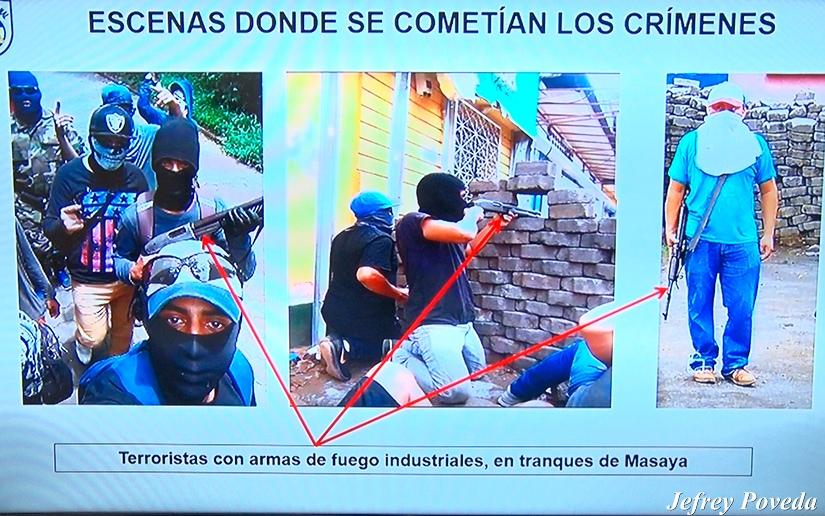
Terrorists laying armed siege on the city of Masaya: a typical opposition tranque
https://www.el19digital.com/articulos/ver/titulo:79650-policia-captura-…
These are serious shortcomings that should invite caution not only because it is the duty of an academic to be rigorous but because what is at stake is the use of human rights as a weapon of demonization against specific governments that happen to be the target of destabilization via U.S. foreign policy. This, in the case of Nicaragua, is being driven by the likes of Marco Rubio, Ileana Ros-Lehtinen, Ted Cruz and others in the extreme right of the Republican Party.
It is not surprising that Ms Francis’ narrative is in denial about the main driving force behind the violent destabilization against the democratically elected government of Nicaragua about which Marco Rubio et al are explicit. What happened in Nicaragua between April and July 2018 was a coup attempt, which was orchestrated, planned, supported, and financed by U.S. destabilisation agencies and with taxpayers’ money, but that failed.
Furthermore, Felix Maradiaga, the most prominent golpista, but also several other leaders of the Civic Alliance went to Washington, funded by Freedom House, to be met by Ileana Ros-Lehtinen, Marco Rubio, and Ted Cruz, to drum up support for ‘regime change’ in Nicaragua by demanding harsh economic sanctions against their own nation. One is therefore hard put to understand Ms Francis’s derision of the view that “the violence in Nicaragua is the result of a failed U.S.-backed right-wing coup.”
Demonizing those who stand for small nations’ self determination
Ms Francis charges the Labour MPs, Jeremy Corby, Emily Thornberry, Dan Carden and Chris Williamson and all those at the Latin American Adelante 2018 conference with having committed almost a crime against humanity by speaking against U.S.-orchestrated ‘regime change’ in Nicaragua. But in order to do this she has to misrepresent what they said. Ms Francis has to explain why Dan Carden MP, is wrong for having said “Trump has no right to promote ‘regime change’ whether that be Cuba, Nicaragua, Venezuela, or anywhere else”. Ms Francis, Trump does not have that right, does he?
In fact, Ms Francis bemoans the fact that the whole Latin America Adelante! 2018 solidarity Conference gave one of its warmest welcomes to the greeting sent to it by Jeremy Corbyn. This is highly revealing of the politics of the broad coalition that openly supports the violent overthrow of the democratically elected government of Daniel Ortega in Nicaragua. They object to the defence of countries’ right to self-determination and they vigorously set themselves against those who additionally oppose U.S.-led, US-financed and US-orchestrated ‘regime change’.
Among the forces that aligned themselves with the defence of Latin American nations’ right to their self-determination and vigorous political opposition to U.S. violent interference in their internal affairs are not just those MPs she mentions, but almost all the UK national trade unions that in specific ways support these principles and have policies on them.
So, it is patently false to argue, as Ms Francis does, that there is an international consensus about the complex Nicaraguan situation. Such consensus, as the Latin American Adelante 2018 conference she so vehemently attacks, shows, does not exist. For Ms Francis the conference’s crime and that of all those who support it, including Jeremy Corbyn, was (and is) to assert “that the violence in Nicaragua is the result of a failed U.S.-backed right-wing coup.”
Dora Tellez, one of the most prominent opposition politicians in Nicaragua, has warmly welcome the passing of the NICA Act by the U.S. Senate because she expects the economy to collapse and the government with it. The opposition party, the MRS, in its twitter account is full of praise for U.S. right-wing politicians for having managed to pass the NICA Act and are praying that Donald Trump signs it
It may be true that some of the other notable individuals mentioned have criticisms of the FSLN government but none of them are calling for ‘regime change’ as Ms Francis and the minority Nicaraguan right-wing opposition does. All of those mentioned in Ms Francis piece in one way or another favour a peaceful solution to the crisis created by the coup attempt.
It is almost certain, in any case, that commentators such as Noam Chomsky and Pablo Iglesias have been taken by the huge and well financed demonization campaign which produced a deluge of misinformation, fake news in almost no time at all, with them having to react to impromptu interviews without having had the chance to look at all the facts in detail.
Pablo Iglesias for instance in the very programme cited by Ms Francis (Fort Apache - which everybody should watch) says “frankly I would say that at least I don’t know all the details, I have tried to access to information in the last days (the programme was in Sept 2018) and the truth is I would say the information is confused, what is clear is that there are demonstrations and it is also clear that there is violence, and it is also clear there are people being killed and this makes the situation to be extremely grave; now apportioning responsibilities right now and distinguishing who is perpetrating what within the current conflict it certainly seems to me at least, premature…” Iglesias goes on to explain that Nicaragua is being subjected to all sort of international pressures, which makes it allergic to external interference. And he stresses “I wouldn’t be able to say what is really going on despite monitoring daily all statements, opinions and facts…”. Thus Ms Francis’s claims are at best incorrect and at worst, misleading.
Thus, to just very superficially quote people, decontextualizing their statements is one of the favourite methods utilised by the U.S. and pro-U.S. outfits and individuals to demonize governments the U.S. doesn’t like, demonization which is particularly intense when the U.S. seeks ‘regime change’.
It is difficult not to draw the conclusion that Ms Francis’ endeavour seeks to make Labour MPs and members of the labour movements who support Nicaragua’s (and other Latin American countries’) right to self-determination, uncomfortable so as isolate the democratically elected government of Nicaragua. The objective result of this would be to facilitate and make easier U.S.-led ‘regime change’.
The international left and Nicaragua
The instincts and principles of the UK Labour movement inclines it to identify in solidarity with small nations’ national sovereignty especially when under threat from big international bullies which is exactly the situation Nicaragua, the second poorest country in the Americas, subjected to aggression from the Trump administration. What Ms Francis is asking in her piece is for the British Labour Movement to abandon this honourable tradition and side with the golpistas such as Maradiaga, the Civic Alliance, and the small but powerful private business sector in Nicaragua, but worse she is condemning the Labour Movement (MPs, trade unions, and others) for actively opposing the extreme Republican right’s aim of violently overthrowing the democratically elected FSLN government.
The parties of the European Left (which coordinates over 40 political parties in West and Eastern Europe that command over 300 MPs in national parliaments) have also made clear their views: rejection of attempts to break the country’s constitutional continuity through violence, and advocating a peaceful resolution of the internal conflict. They specifically reject “the interference of the United States, which, as always, add fuel to the fire in countries whose governments do not follow its guidelines, using the tactics of a "soft coup" that we have already seen in other countries of the continent.”
The Sao Paulo Forum (that organises mass political parties of the Latin America Left such as Brazil’s Workers Party and Mexico’s Lopez Obrador MORENA) issued the following statement on July 20th 2018: “Strongly reject the interventionist policy of the United States in the internal affairs of Sandinista Nicaragua, a country that is implementing the same formula used by US imperialism in countries that do not respond to its hegemonic interests, causing violence, destruction, and death through the manipulation and destabilizing action of terrorist golpista Right groups, which boycott the pursuit for dialogue that constitutes the best way to overcome the current crisis and achieve peace, which is essential for the continuation of the process of social transformations promoted by the FSLN of the government headed by Commander Daniel Ortega, which has significantly reduced poverty and social inequality in this fellow country.”
Ms Francis’ argument that there is an international consensus of condemnation of the FSLN government is therefore, thoroughly false. It smacks more as media propaganda and it does not stand to rigorous scrutiny when confronted with the facts.
Thus on the one hand you have a de facto international progressive alliance involving dozens of organizations that command tens of millions of votes (the Workers’ Party alone obtained 47 million votes in the last election and Lopez Obrador got over 30 million) that support the small nations’ right to self-determination and their national sovereignty against U.S. aggression and U.S.-backed ‘regime change’, such as Nicaragua. On the other, there is a much better financed world coalition, led by Trump and the Republican extreme right wing (Marco Rubio et al), and which involves the extreme right wing in Nicaragua, most of the minority conservative forces in the private sector and with the decisive support of the world corporate media.

One of the many marches organised by the FSLN advocating peace, opposing violence and demanding peace in Nicaragua.