El 19 Digital, November 13th 2018
https://www.el19digital.com/articulos/ver/titulo:83869-diputado-carlos-…
Sandinista Deputy Carlos Emilio Lopez explains the importance of the proposed State Policy for a Culture of Peace and Reconciliation
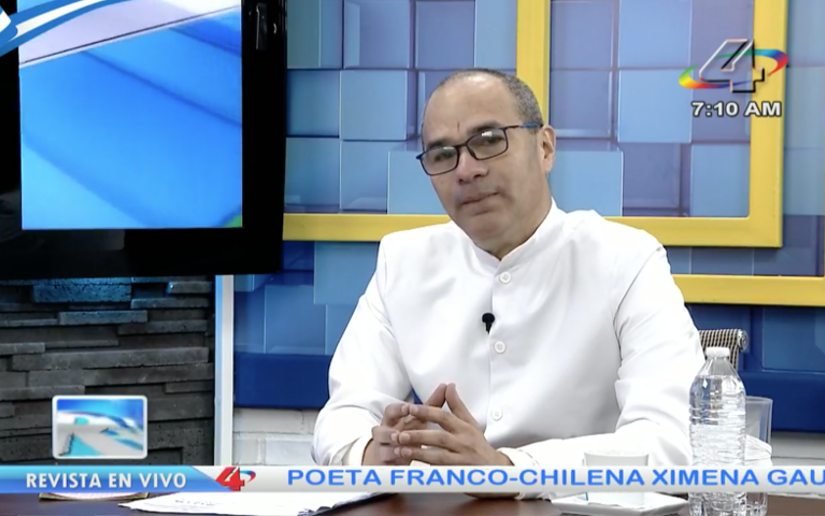
Sandinista Deputy Carlos Emilio Lopez explained in the En Vivo television program the objectives and reach of the proposed State Policy for a Culture of Peace and Reconciliation on which a national consultation is about to conclude.
Deputy Lopez said the national policy to promote a Culture of Peace and Non-Violence, a State policy, is a public policy aiming to bring together principles, values, attitudes, behavior and life styles so as to install a Culture of Peace.
“It’s a culture of understanding, of peaceful co-existence, of harmony between all Nicaraguan families; a culture of peace, of multi-dimensional non-violence, touching all human relations” Lopez said.
He went on, “This policy, which is a public policy because it’s directed towards individuals, families and communities, is focused on the human person and we say it aims to promote a multidimensional culture of peace because it is rooted primarily in the family which is society’s basic nucleus, the primary space for socialization, the ambiance in which we learn values, principles, ways of being and existing, ways of coexistence.
The family is central
“The family is the natural space for assimilating and empowering ourselves with this culture of peace, but so that it later irradiates outwards into other spaces, for example, the school, the community, the workplace, religious spaces, in other words, in all the places where we are born, grow up, produce, wherever we develop as people, everywhere Nicaraguans coexist and cohabit…The idea is to assimilate ways of communicating and solving our problems peacefully, by alternative ways of conflict resolution so that we use dialogue and empathy, listening so as to be able to resolve our differences.”
Intensifying Social Programs
Lopez stressed that “This proposal of a National Policy of a Culture of Peace and Non-violence has been worked out by our Government of Reconciliation and National Unity treating the family as central” and Deputy Lopez goes on to note that Peace “is a global longing, a collective longing since all cultures have yearned for peace and in Nicaraguan culture peace has always been something long wished for. So while this proposal takes the family as central in fact all the government institutions participate in its implementation, in a systemic, inter-institutional, coordinated way, including the Ministries of the Family, of Education, of Youth, the Directorate of Youth Affairs of our national police, the Ministry of Health and so on.”
“Over the last twelve years, our government has been working in an articulated way with all our institutions treating the human person as central. So that this policy too aims at articulating together all the social programs that focus on individuals, families and communities, like the Program of Love for Very Young Children, the Road Map to Eradicate Child Labor, the nutrition programs, the community education programs, the dynamic of the Family Guidance and Community Education Guidance programs, the system of Schools in Values, the system of Schools for Parents...all the work we have been developing so as to prevent the various forms of violence.”
“This policy is a proactive policy, a preventive policy, trying to avoid conflict and all forms of violence, violence in relationships, physical violence, psychological violence, sexual violence, parental violence, violence between couples, inter-generational violence.”
“It’s a policy with a gender perspective and also a generational and intercultural perspective and the idea is that independently of differences we may have in age, sex, culture, religious beliefs, ideological or political beliefs, independently of all those differences we should be able to coexist and cohabit harmoniously and in peace whether as couples, in relations between women and men, across generations, in the relations between mother, father and children, so children respect their parents and grandparents and parents their children, so men respect women and women, men; so that students respect their teachers and teachers their students; so that we respect old people , so that we respect the original peoples and afro-descendent peoples and all cultures, recognizing that we are a single Nation, multicultural, multiingual, multiethnic and we should respect that cultural diversity.”
“The idea is that we respect the cosmic vision of the original peoples and afro-descendent peoples, that we respect traditions, customs and ways of being, respect local and municipal identities, regional and national identities...That we learn to live united in diversity. This policy aims towards this, towards National Unity.”
The bases for the Policy of Peace and Non-Violence
Carlos Emilio Lopez went on to note that the basic input for this policy has its sources in different currents including Christianity, Christian values and principles derived from the Gospel and the message of Jesus, “The Prince of Peace is full of the message of harmonious coexistence, “Blessed are the peace makers because they will be called Children of God"….And Saint Paul said, for example, that we have been entrusted to be ministers of reconciliation where no one is barbarian or jewish, nor slave nor free, but Christ is all and in everyone… so this message of unity in diversity is based on that and is the basis for this policy of Peace and Reconciliation”
Socialist ideals
But as well as Christian principles and values, other currents also feed into this policy, Lopez goes on, “Socialism preaches the collective spirit, the common good, the wellbeing of all society, the socialization of material and spiritual goods... so this policy is inspired too by practical solidarity, the practice of empathy, in trying to identify with the problems, needs, demands and aspirations of al the human groups in Nicaraguan society… That is solidarity, identifying yourself, submerging yourself in social problems and demands and seeking to resolve them.”
Another source of this policy of Peace and Reconciliation is the national and international legal order. The policy includes elements of the international human rights treaties in every area, treaties which Nicaragua has signed and ratified. These include international agreements on issues involving children, women and the family, the environment, development in all fields. And it also contains elements from Nicaragua’s national legal provisions, the Political Constitution of the Republic and all its subsidiary legislation.
Lopez explains, “That is why the Policy of Peace and Reconciliation lays out that its fundamental objective is to strengthen the social and democratic legal order...taking as its guide fundamental principles of the Nicaraguan nation, freedom, justice, equality, fairness, social and community participation, representative and participatory democracy, all in the search for the common good and full respect for human rights, be they political, civil, economic or cultural.”
A culture of human rights
For Lopez, the Policy of a Culture of Peace and Non-Violence is a human rights policy because “All human rights are going to be articulated by means of this policy in the implementation of current social programs”.
Among the programs Lopez mentions are the Program Love for Children at Risk, for example children with disability, children from homes in conflict, children whose parents are in prison, or children whose parents live with HIV… “In other words, very diverse groups of children, regardless of their particular difficulty...children working, children in rural areas, children from our original and afro-descendent peoples.”
Deputy Lopez also mentioned the Program Love for the Smallest Children which serves children aged from newborn to age six and which coordinates programs aimed at newborn infants, children in preschools Community Infant Centers among others… “That’s why in this policy the basic document of Love for the Smallest Children is going to play an important part because it is a community base popular document already shared by the Ministries of Health and of the Family in every community in the country.”
Lopez explained that the policy intends to follow the natural cycle of child development guiding educational processes, nutrition practice and early stimulation for children focusing on life cycles newborn to six months; six months to one year; one year to three years and three years to six years. Via that process the policy seeks to give integral attention and care to all children with the full participation of the family.
Developing capacities
However, at the same time, this policy aims to to stimulate people taking initiatives involving the innovative creativity of all Nicaraguan families.
"We say that this policy is a human rights policy, it is not only the promotion of a discussion about peace, it is the promotion of a practice of peace and it hasn't come up just in the last few weeks, this policy resumes government practice for the last 12 years." says Lopez.
"The practices of good government, the practice of social policies and programs that have successfully lowered infantile mortality and maternal mortality, in which nutrition levels and nutritional security have been raised, in which we have achieved the lowering of all indicators of violence."
"This policy aims to deepen and consolidate this way of life in which we resolve our problems by dialog, with tolerance and understanding", he insisted going on to note that there are two ways to manage public policies. "There are two paths, two schools of thought , two paradigms."
Lopez explained that one is is a public policy based on theory, based on ways of understanding and interpreting society, by investigating and theorizing and then, afterwards, putting the policies into practice. In reality, this was the previous administrative model. “The process of formulating the policy took 3 or 4 years and the definition of aims, and indicators, another year. Therefore at the end of the government's five year term, the next administration arrives and begins again from the beginning, the cycle of an elaboration of a policy. The policies remain as something that might have been, as an ideal proposal, a goal to be reached.”
“The second school of thought consists of going from the practice to the theory, from transformation and action to the conceptual model, which is the practice of our government."
"The complete policy has been in practice for these past 12 years, through a diverse series of programs and models, put into practice by the Ministry of Health with a model of family and community health in which health is a human right, a social good constructed with the participation of the community and the family. This model has been successful in that we have been able to prevent contagious illnesses, imune preventables, we have eradicated epidemics, we have had success in promoting healthy lives in our communities."
Deputy Lopez points out that during recent epidemics, Nicaragua has been the least affected, recalling also that this model has been successful in the Education Ministry whose strategic plan has improved the numbers of students in education and the quality of that education. All educational indicators have improved; scholastic achievement, retention of pupils, students graduating from one year to the next, the atmosphere in the schools themselves.
"Twelve years ago the schools were destroyed, without roofs or floors, without desks or black boards or laboratories or libraries, without safe drinking water."
"In twelve years we have brought dignified conditions to the schools, improved teacher-student ratios, improved the educational curricula, introduced an interactive didactic model between teachers and students, in which the educators are learning and the learners are educating, in other words, the educational population creates knowledge. We have universalized education and improved the quality, relevance and inclusivity of education."
The Family
He mentioned that the Ministry of the Family has been promoting Family Schools for mothers and fathers., promoting a family model of tolerance, a family model in which the way of bringing up children is with tenderness, love and dialog and leaving behind the traditional model based on shouting and forms of violence such as hitting, pushing and beatings. In other words, an unlearning of the models of bringing up children passed on from generation to generation in which the Ministry of the Family has played an important part.
The end of child labor
The Ministry of Labor has begun the way to eradicate the participation of children in the work market. There have been fewer and fewer children involved in work. Twelve years ago, 20% of the work force was under 18.
"We found children in the coffee and sugar cane harvests, in the tobacco fields and working with animals; we found boys and girls in all the productive categories. Today fewer and fewer children participate in the world of work and more and more are integrated in education.”
"Therefore the success of all these programs which I have mentioned, has contributed to reducing poverty, in forming a human capital the profits of which are socialized. This practice of peace is a policy that produces the full development of the Nicaraguan family. The policy of the culture of peace and non violence is a policy of human development, economical, social, cultural, institutional and spiritual. Development in every sense, as we are promoting development of education and health, of community participation, of social prevention and spiritual development because we are going to improve human relations in the family.... recognizing diversity".
“The fundamental objective of the policy of peace and non-violence is to eradicate discrimination, to eradicate all forms of discrimination.”