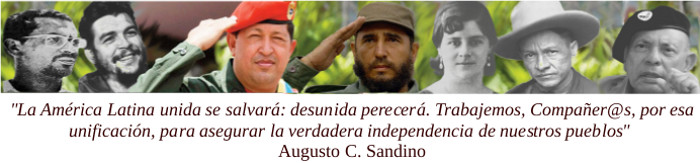
Alex Anfruns, Journal Notre Amérique, June 16th 2018
http://correonicaragua.org/index.php/textos-de-actualidad/125-en-nicara…
Thrown into the spotlight beginning around the middle of April, the birthplace of Sandino still faces an intense political crisis. As of now it seems as if it is approaching the final resolution. On one side, the Nicaraguan people is continuously mobilizing towards working more closely with authorities for helping to dismantle the barricades in the homes of insurgents. On the other side, there have been two big marches for the peace in the past week. Despite the wishes of opposition sectors and the spokespersons for the student administration, the message of Daniel Ortega during the march for peace on June 7th in Managua was clean and clear: “Here the constitution of the Republic, through the people, establishes the rules. If those attempting the coup want to become the government, they should gain the votes of the public in the next election. With all of the destruction they have caused, we can see what support they will have”. But such a statement is minimal compared to the discourse of private media and main news agencies, who continue to refrain from discussing the progress being made in the region and are rather blowing on the embers of the dispute. On which side will the balance finally tilt?
A Terrible Scheme of Propaganda
In a recent article, I examined a series of contradictions in the discourse about Nicaragua in the international media. There I talked about one of the principles of war propaganda, which is to The invention of the aggressor and the victim is one of the initial beginnings of propaganda surrounding the war, which is to switch the aggressor and the victim. The plan goes as follows: first a sector of the opposition who denied the dialogue with the government wants to control certain parts of the capital and other cities by establishing barricades. These areas are considered to be “free of tyranny” and represent the beacons of the insurgency which they can use throughout the country to deter the operations of “repression” of the local police forces. This tactic of deploying barricades has been theorized as an effective medium for preventing government forces from gaining control of national territory, because it’s “impossible for the government to disburse sufficient personnel to control every centimeter of the country.” The first evidence that must be highlighted is that Nicaragua has not been facing a completely spontaneous crisis which surfaced out of popular mobilization, but there is an established insurgent plan with the capacity to confront the authorities for months. We are facing the primary phase in the development of an unconventional war to dismantle a democratically elected government.
As time moves forward, there have been a significant number of confrontations in these “freed” areas at the hands of the opposition. At this point, it is apparent that the activists who are defending these borders are not the peaceful protesters that the media claims them to be. The images of masked youth yielding homemade mortars and other explosive objects are impossible to hide. In fact, including such images helps to create a “romanticized” dimension of popular resistance in the context of a face to face with the professional police force. This is where the second phase of the unconventional war comes into play. The dominant newspaper, aligned with powerful media corporations, has contributed to the production of a dominant and one sided narrative of the current crisis. It is easier to identify with a youthful protester who is protesting in rebellion of the government than it is to identify with a young police official who is obligated to use force to enact and obey the law. Thus, when there have been dead bodies around the barricades, it has been complicated for an outside observer who knows the truth about what happened.
Who doesn’t want to know anything about these victims?
Nevertheless, anybody who does a small amount of research on the news of private media companies can easily see that this idealized story of the current situation simply serves to dismantle government action. Nobody is asking the crucial question: “Was the victim a pro-government Sandinista who was helping the police to dismantle the barricades? Or an opponent of the government who was defending the barricades?” Many testimonies in favor of the latter have been systematically discarded! Thus, the private media plays a fundamental role in the overstretched credibility of the opposition forces. Would the opposition be manipulating the memories of past victims with the complicity ofl private media in Nicaragua? This is what we demand to know: What happened to the numerous cases of victims who have been proven to be members of the pro-government side of the conflict? In the frame of conversations of peace, the Nicaraguan government first accepted that the CIDH directed an observation mission people on the Right in Nicaragua. This acceptance was later revoked upon finding out that the information did not include description of many cases of attacks on civilians, including public officials, which resulted from violence unleashed by opposition forces. Here we have recent examples which illustrate a situation with many more nuances than have been described by various news sources.
- On the 19th of June, the authorities overthrew an operation in Masaya to liberate the of the Assistant Director of the National Police Force Ramon Avellan and his agents, who were entrenched in the police station, surrounded by barricades until June 2nd. Every night, the protesters shot mortar shots at the police station, accompanied by yelling threats such as “What did you think? That there are just pansies in this fight? Try again, my little sister…” Later, the mortar bullets resumed close to the police station...with a warning of “playful” content, a video emerged in which the protesters sang threatening songs against Police Commissioner Avellan, accompanied with shots. According to the organization ANPDH, 6 people, including 3 whose identity has not been confirmed, were assassinated in various surrounding neighborhoods as a result of the police rescue operation.
- On June 30th, during a march of the opposition, a protester was assassinated by gunshot. A video captured several minutes before the tragedy by a reporter who was on the scene, demonstrated that the opponents surrounded a police official and asked that he give them his weapon and simulated that he was taken hostage to justify this. Later, the images showed a person who was close behind the police officer robbed the officer’s rifle at gunpoint. Later, the protesters attributed the death to government repression.
- On July 3rd, 2 people were kidnapped in Jinotepe by a masked and armed group: police major Erlin García Cortez and Enacal worker Erasmo Palacios. Three days later, Bismarck de Jesús Martínez Sánchez, a worker of the Matagalpa town hall, was also kidnapped. One week later, the parents have not received any information about them.
- On July 5th, the dead body of the national police Yadira Ramos was found in Jinotepe. She had been kidnapped, raped, and tortured. She was seen being forced to get out of her vehicle, and her husband was assassinated in the act.
- On July 6th, a member of the FSLN Roberto Castillo Cruz was assassinated by opposition thugs who had placed barricades in Jinotepe. His child, Christopher Castillo Rosales was assassinated just a week before him. In a video published slightly before his official assassination, Castillo Cruz denounced his assassinators: “This criminal group of the right has killed my son, I just ask for justice and that peace prevails so that our children don’t lose their lives”
- On July 8th, on an overnight confrontation in Matagalpa, a 55 year old man named Aran Molina was assassinated while Lalo Soza was rescued, a Sandinista activist who was being attacked. A day later, the FSLN paid homage during a procession. The same day, two other people were assassinated: the social worker Tirzo Ramon Mendoza, who was executed by masked men after he was kidnapped, and a third victim whose identity remains unknown.
- On the 9th of July, the authorities dismantled the barricades which were blocking the circulation of the cities of Diriamba and Jinotepe. Many of the residents later gave their testimonies about the many violent actions of the opposition, including torture of Sandinistas. At the same time, representatives of the Episcopal Conerence arrived. The citizens of Jinotepe congregated at the church, where they encountered opposition forces who were disguised as religious citizens. Residents accused church officials of protecting the opposition forces and not doing or saying anything to stop the violence created in the previous two months. In Diriamba, local citizens also described a hidden arsenal of mortars in the church of San Sebastian.
- On July 12th, a criminal group attacked the City Council of Morrito in Rio San Juan. A historic fighter for the Sandinistas, Carlos Hernandez, was kidnapped there. Seriously injured and unable to escape, a young Sandinista activist, two police officers and their superior were assassinated. A Sandinista activist was hit with a bullet in the stomach. Later, a schoolteacher Marvin Ugarte Campos succumbed to his injuries and passed away. The story of the opposition? They are stating that the massacre was a “self-attack of the paramilitaries!”
It seems that some deaths and violent acts are treated with no value, while others are treated as martyrs for a sacred cause. Finally, does the situation depend on the lenses with which we look at reality? Have they already placed us one one side of the conflict without us knowing, or even suspecting it? If so, is it a waste of time to form our own opinions based on analysis of the facts? The search for peace and the truth stops us from falling into this type of resignation.
In a notable 46 page long work called “The Monopoly of the dead, and how to inflate the numbers in order to blame the government”, Enrique Hendrix identified the numerous inconsistencies in the reports issued by the three principle human rights agencies, the CNIDH, the CIDH, and the ANDPH. When comparing the various reports from the beginning of the crisis until the most recent reports (April 18th until June 25th), it was found that the three organizations registered a total of 293 deaths. In 26% of the cases (77 citizens), the information regarding the deaths is incomplete and has not been verified. In 21% of the cases, (60 citizens), the deaths were of people who had been assassinated by opposition forces, and were public officials or Sandinista militants who were killed while helping the authorities to dismantle the barricades. In 20% of the cases, (59 citizens), the deaths were protestors, of the opposition or those who were creating roadblocks. In 17% of the cases (51 citizens) the deceased did not have any direct relation to the protesters. Finally, in 16% of the cases (46 citizens), the deaths were of passersby who did not participate in protests.
As can be seen in this study, the balance sheets of these organizations lack rigor and mix all kinds of victims (gang fights, traffic accidents, vehicle theft murders, conflicts between farm owners, police officers, pregnant woman in an ambulance blocked by barricades ...). Conclusion: if we take into account the exact circumstances of each death, it is obvious that we cannot attribute responsibility only to the government. In light of these elements, we have the right to question the international media about their lack of objectivity. Why such an alignment with an opposition sector that has declared itself fiercely hostile to any dialogue?
Who wants nothing to do with the dialogue?
This mechanism of propaganda is complete with the “blackout” of other information which is not considered relevant. Nevertheless, while the media is focusing on the conflict, other sectors of the opposition are continuing to participate in the various sessions of the “tables of dialogue for the truth, peace, and justice”, organized to listen to the different points of view and to attempt to identify responsibility in the wave of violence which is affecting the country. The final conclusion of the various observation missions of human rights in Nicaragua have not yet been delivered, because there is continued debate regarding the new developments in the region. But what can we expect from a dialogue between the two sides when many observers have already decided beforehand that the government is solely responsible for the violence?
All over the world, the role of the police is to repress in cases where there is “perturbation of public order”. But it is difficult to understand why the authorities in Nicaragua would order an attack on civilians in a savage and arbitrary manner while carrying out a dialogue for peace at the same time. On the other hand, one would expect this from those who refused to participate in the tables of dialogue and tried instead to sabotage them, seeing an interest in derailing the process. In this case, it is likely that on various occasions masked thugs were able to pass as para-police forces.
Such a concept is not less credible than the version of the same hooded figures, who have said that the government of Daniel Ortega gave a green light to camouflaged citizens to destroy public infrastructure and kill other citizens! Even so, the government did not deny that in the beginning of the crisis, some police agents at times used a disproportionate amount of violence, and responded that justice will have to determine the responsibility of actions punishable by law. The National Assembly did its part by creating an initiative to develop a “Commission for the Truth, Justice, and Peace” with the objective of determining responsibility of the human rights violations in Nicaragua within three months.
But in the story that the main media sources have fabricated overnight and are broadcasting online 24 hours a day, it is not even conceivable that the government of Nicaragua has been facing difficulties whose causes are complex and multiple. The exaggeration of the media and the positions of foreign politicians become irrefutable evidence and has served as a replacement for justice! Just as in the case of Venezuela in recent years, to manipulate the public in this way is an insult to the intelligence of the people. Of course, not all is explained through the tentacles of the octopus of imperialism. However, anyone seriusly interested in the history of inter-American relations during the past two centuries, should remember the weight o fhistory and ot dismiss it contemporary relevance.
How to Export Democracy With Dollars
It seems as if more than a few observers, shocked by the rapid development of these labyrinthine events, cling to condemning Ortega’s government like Aridane’s thread in the myth of the minotaur, moving towards a single outcome, demanding early elections:...Here is the problem: there are Latin American countries in which the murder of trade unionists, peasants, and social leaders have been common for years, where the peace efforts of governments are considered by the majority to be totally ineffective, among the worst of such cases, are Colombia, Honduras, or Mexico...and they are concerned with nothing more than the appearance of their “democracies”. There’s something not quite right here..right? To clear up this mystery, it’s worth it to consider a quick recap of the history of the 20th century.
The coups and destabilizations encouraged from outside forces, as in the Dominican Republic or Guatemala, have taught us that in the second half of the 20th century, the context in Latin America continues being marked by Monroe Doctrine military interventions and the“Manifest Destiny” of the United States, which was nothing more than an imperialist policy designed to control the resources and raw materials of Latin America, what is now known as an anti-communist “crusade” in the context of the Cold War. But the domination of the United States is not limited simply to the demonstration of brute force by invasion of troops to enforce a “regime change”, but also consisted of methods of cultural domination, in particular through the so-called “development aid policies”.
In his speech in the January of 1949, U.S. president Harry Truman classified for the first time non-industrialized countries as “underdeveloped” countries. Thus, in 1950 the US Congress implemented a law for international development (AID, Act for International Development). In 1961 a law of US Congress substituted AID for USAID, which implemented a new vision, more integral than development support sent to any place on the planet. As was seen in the coup against Jacobo Arbenz in Guatemala in 1954, the anti-communist fight was just a front. The primary concern of the United States government was to avoid the development of a national conscience within the armies and police forces of “undeveloped countries”. Because of this, between 1950 and 1967 “the government of the United States spent more than $1.5 billion in military assistance for Latin American countries. (1)
After the victory of the Cuban revolution of 1959, John Kennedy launched the Alliance for Progress in 1961. This was a similar initiative to the Marshall Plan in Europe. Between 1961 and 1970, the Alliance for Progress provided an investment of $20 billion in economic assistance for Latin America. One of the incentives was the stabilization of the regimes which fought against the Communist influence of Cuba.
“John F. Kennedy and his consultants have designed a plan of intervention of the region, the Alliance for Progress, which consists of an investment of $20 billion for economic development and a massive military assistance. The 60s are marked by the formation of a new generation of Latin American militaries and the transfer of technology and capital from the US military to Latin America. The Pentagon and the CIA have elaborated their strategy to stop the advance of socialism: The Panama School of the US military [School of the Americas], which trained the cadres of the Latin American armed forces.” (2)
Behind the false concept of the “development policies”, the “creation of armies and police forces” and the “military assistance for reactionary and pro-imperialist regimes”, such policies offer the already monopolizing powers “the most favorable conditions for exploiting underdeveloped countries”. In other words, such “assistance” represents above all political leverage in favor of the economic interests of primarily Northern countries. These countries make up the OECD (Organization for Trade and Development), founded in 1961 and also known as the “club of rich countries”. This organization was formed by 27 countries, primarily in North America, Western Europe, and Japan.
Sooner or later, the resistances emerge
But the new reality, a result of the decolonization of Asia and Africa also represented a new consciousness: the strength of free countries now resides in their unity. This allowed them to exercise some influence in the agenda of the United Nations and to defend “the rights of autonomous development”. Thus, in the 70s, the United Nations Conference on Trade and Development (UNCTAD) issued an important initiative to defend the interests of Group 77. Created in 1964 in a joint declaration of the 77 countries, the results of UNCTAD were considered a historical turn.
The invasion and military occupation of Nicaragua by the United States led to increased appreciation of the historical value of the Sandinista Popular Revolution and the resistance to foreign interference in the 1980s. The increased financing of the Contras by the CIA after the increase of drug trafficking in Central America was proof that such tactics of interference were not infallible. Despite the numerous interferences and destabalizations which were suffered throughout history, the peoples of the South have an advantage over the powerful: collective memory and intelligence.
After the repression by dictatorships, the debt crisis, and the reign of the IMF in the 70s and 80s, Latin America would experiment with many social uprisings in the 90s, paving the road for the emergence of new progressive governments in Brazil, Ecuador, Venezuela, and Bolivia. The next step was the formation of the Bolivarian Alliance for the Peoples of Our America (ALBA), a cooperation agency created in 2004 to deter the project of the Free Trade Area of the Americas (FTAA) of the United States.
What remains today of the past’s interferences?
Since the end of the Cold War in the 1990s, the “assistance” of the United States could no longer use the pretext of containing communism around the world. This, the U.S. adopted the narrative of “anti-terrorism” or “anti-drug and security policies”. These are the primary justifications for U.S. assistance in Latin America: $9.5 billion for Colombia; $2.9 billion for Mexico, and since 2016, the assistance to all countries in the Northern Triangle of Central America (El Salvador, Guatemala, and Honduras) has surpassed the first two. (4) This explains the systemic condemnation of certain countries and not others, to the detriment of reality and the level of violence.
Nevertheless, the Cold War mentality did not end for some. Thus, the secretary general of the OAS, considered it necessary in 2018 to bend to the demands of the White House and harass day and night countries such as Nicaragua and Venezuela, at the risk of appearing grotesque. Indeed, when in a special session of the OAS the US spokesperson criticized the violence in Nicaragua and attributed it exclusively to the government, can we take his word as the bible? It’s best to remind him that his country does not have any legitimacy to speak on behalf of Nicaragua, as its involvement in Nicaragua consisted of 21 years of invasions and military occupation, and 43 years funding the Somoza dictatorship!
The “conservative restoration” in recent years, with the “soft coups” to derail Lugo in Paraguay, Zelaya in Honduras, Rousseff in Brazil, the failed peace talks in Colombia, the persecution of Jorge Glas, Lula de Silva and now Rafael Correa, provides the perfect context for the OEA, an obsolete organization, to finish even with the memory of social conquests of recent years.
In order to reach its goals, the USA must use the power of media within reach. Thus, it is no surprise when Freedom House, financed by USAID and the National Endowment for Democracy (NED), decided to create a specialized group for fighting the FSLN in Nicaragua in 1988. It’s always interesting to listen to the cofounder of NED Allen Weinstein, who said: “Many of the activities that we are doing now were done by the CIA 25 years ago. The main difference is that when these activities are carried out openly, the likelihood of failure is zero. That opening is its very own (guarantee of) protection.” (5)
Today, the interference continues to finance opposition movements, supervised in training programs for “young leaders”, willing to defend with nails and teeth the values of the sacrosanct “democracy” and to determined to dismantle the “dictators” of their countries of origin. Between 2014 and 2017, NED funded $4.2 million to Nicaraguan organizations such as IEEPP, CPDHN, Intermedia, Let’s Make Democracy, and the Nicaraguan Foundation for Economic and Social Development. And of course, if we remind the youth opposition and their sympathizers of this, they act as if they don’t understand...
While it may have been extremely effective in some countries such as Ukraine in 2014, the pattern that we are describing must be confronted with the reality and unique political traditions of each country. In Nicaragua, the FSLN is a strong, dominant political force which has won democratically in the past three elections. It is significant to note that the opposition sectors who depend on the support of the U.S., and right wing forces must use references to the Sandinistas in order to gain credibility. Nevertheless, this practice goes too far when they try to compare the Sandinista government and the Somoza dictatorship, thus demonizing Daniel Ortega.
The march for peace called by the FSLN on the 13th of July which pays homage to the 39th anniversary of the “tactical withdrawal” of Sandinismo in Masaya, is a new demonstration of the strength of the Nicaraguan people and their willingness to defeat the violent strategy of the opposition. Will the people of the world live up to the solidarity that this moment demands?
Notes :
1) Yves Fuchs; The coopération. Aide ou néo-colonialisme? Social Editions. Paris, 1973, pp. 55
2) Claude Lacaille; In Mission dans la Tourmente des Dictatures. Haiti, Equateur, Chili: 1965-1986. Novalis, Montreal, 2014. p 23.
3) Gustavo Esteva, "Development" in SachsWolfgang (coord.) Dictionary of Development, Lima, PRATEC, 1996. p. 52
4) https://www.wola.org/es/analisis/military-help-of-estate-united-in-lati…
5) Washington Post, September 22, 1991.