Warwick Fry *, June 27th, 2018
Working in the media environment I like to think I am inured to disinformation, misinformation and spin. I tell my Mum it’s no use her yelling at the TV set - although at times I have felt like hurling a brick through the thing myself.
A recent trip to Nicaragua left me gob-smacked at the blatantly perverse and malicious misrepresentation and distortions that have been emanating from that beleaguered country since the ultra-violence of last April - violence that is escalating even as I write.
What began on April 18 as a small (about 60 strong) student demonstrations against social security reform (a saga of disinformation in its own right) was hijacked by armed violent elements who must have been preparing for a trigger event for months. Confrontations with the police were then reported as a ‘massacre of unarmed students’.
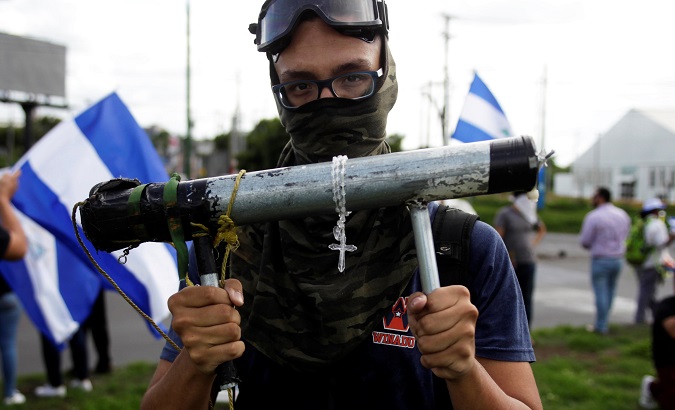
Within days President Ortega had responded by withdrawing the police, cancelling the contentious social security reforms and calling for dialogue. By then, pension reform had been forgotten and demonstrators were calling for Ortega’s resignation.
There were many outrageous claims made in the last weeks of April. Underpinning them was the initial reflexive assumption that it was another ‘colour revolution’ with police violence and a repressive authoritarian regime a given. It was textbook Gene Sharp.
Never mind that of the 200 injured in the first five days, 128 of them were police confronting home made mortars (thousands of rounds - who paid for them?) and firearms. Never mind that Daniel Ortega won his second election with 72% of the vote. Never mind that Nicaragua had the best economic and social indices of the region. The Nicaraguan protests were tailored to fit the ‘regime change’ media template.
Central American and Mexican, not to mention other international media fell in with the ‘official’ narrative. On the ground it is another story. A long time Irish resident Stephen Sefton, has been working on educational and community projects (including a women’s shelter and legal service) for twenty years. In an email he wrote:
“Family after family have come forward denouncing opposition media lies and manipulation of their loved ones deaths. The opposition media film attacks by their gangs and then publish that material as if it were attacks by Sandinistas"
These claims are corroborated by instances of police being kidnapped and stripped of their uniforms, and casualties allegedly caused by police violence turning up alive and indignant. He goes on to write:
"We sleep three or four hours a night because we are alert and prepared for attacks from the opposition gangs who have attacked and burnt or ransacked 23 schools across the country. Eventually, [President] Ortega will order the police to impose order, but everyone is getting very worn down while we wait for that to happen.”
Another resident US citizen John Perry (not a personal fan of Daniel Ortega) describes how he participated in a peace march of around 1000 people in Masaya that was attacked by anti-Sandinista mobs, and a building burned down.
Over two months into the violence, (over 170 dead and 2100 injured) I am seeing belated, grudging acknowledgement that there are gaps in the ‘official narrative’; that it is contradicted by facts. That the majority of casualties are Sandinista supporters. That it would hardly make sense for the government to destroy public radio stations, its own government offices (over twenty), buses, 55 ambulances (stolen, damaged or destroyed) over twenty schools, an iconic craft market and hundreds of small businesses and supermarkets. Remaining undamaged supermarkets were empty for weeks before the road blocks were cleared that also prevented thousands of employees getting to work.
A part of the problem is that highly placed organisations accept the tainted opposition reports at face value. Amnesty International put out one such report titled ‘Shoot to Kill – Nicaragua’s strategy to repress protest’ ”. A former prisoner of conscience sponsored by Amnesty International (Camilo Mejia Godoy, Nicaraguan born conscientious objector to the Iraqui War) wrote a scathing open letter cogently exposing the biases and false allegations of the report. His account has beeen slowly taken up in US independent media (mainly The Real News’).
Despite the representation of the Ortega government as a repressive regime, most of the Nicaraguan media is owned by private interests. The majority are hostile. Initial reports alleged a non-existent “massacre” of peacefully protesting students on April 18th. In fact, one student may have died, but the government disputes that.No media reported the mob attacks on municipal buildings in several cities, including Granada, Masaya, Chinandega and Estelí nor President Ortega’s decision to withdraw the police from the streets, an opposition precondition for the dialogue proposed by the government on April 21st
There is belated recognition by the OAS (Organisation of American States) of the gaps in the ‘official narrative’; that the violence is not government instigated. Ortega has signalled a willingness to bring elections forward to next year. On June 4th and 5th at the OAS General Assembly there was a strongly worded exchange between OAS General Secretary Almagro (with a reputation for dodging controversy) and lobbyist for the opposition Mariadaga, after the OAS defeated a motion to condemn Ortega. Almagro accused Mariadaga of being ‘deceitful and misleading’.
‘Mediating’ Catholic bishops who openly support the opposition (there are reports of priests encouraging violence at the road blocks, including one priest involved in the looting) have also been denounced by the Evangelical (Protestant) religious authorities.
Arrested gang leaders working inside one of the private Politecnic University have provided direct proof that the violent gangs were armed and paid by organised crime networks with links to a Mexican arms trafficker. The ringleader is alleged to be connected with opposition lobbyist Mariadaga, now in the US lobbying the OAS.
Two months later since writing the last two paragraphs the death toll has climbed close to 200. A Sandinista supporter was killed and burned in the street and on the same day a household of a Sandinistas was burned down; four dead, two of them children. Other deaths and assassinations show a deliberate targeting of Sandinista identities and supporters.
It will be interesting to see how the mainstream media deals with this unravelling of the plot. Probably by just ignoring it – Nicaragua will simply disappear from the world news pages leaving a residual negative first impressions.
Publications like community papers, and community radio provide a space and a platform for independence. While the Internet means anyone can blog, tweet or post to Facebook, the best blogs, the ones that serious people take seriously, are anchored (‘branded’ if you like) in trustworthy on line publications.
The (non violent) ‘bricks’ that we hurl at the unconscionable.
* Warwick Fry is an Australian journalist who has reported for forty years on Central America.