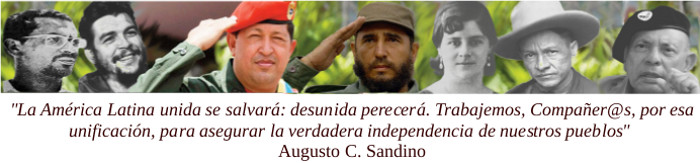
Fabrizio Casari, Altrenotizie, January 11th 2022
https://www.altrenotizie.org/primo-piano/9507-nicaragua-la-sfida-proseg…
 Managua. In a sober ceremony, Comandante Daniel Ortega began today his fourth presidential term. In the presence of international delegations representing 21 countries, and more than 300 representatives of parties and movements from Europe, the United States and Latin America, among red and black handkerchiefs and white guayaberas, the Comandante wore the presidential sash for the fourth consecutive time. This marked the beginning of a new mandate for the Sandinista leader, which returned the FSLN to its natural role, that of government.
Celebrating the event, together with his people are his friends, comrades and brothers. Those who have always and forever been the shield, the most recent ones will become it. They are the front line of upright, vertical people who create innovative ideas. Women and men who have changed the destiny of their respective countries, not the accounts of their respective bankers. It is about shared analysis and shared objectives, internationalism and friendship; it is a common front based on mutual respect and reciprocal solidarity, which is the concrete implication of friendship.
There is Nicolás Maduro, president of Venezuela, besieged but victorious, capable of descending into hell and rising again using the fast track. There is Miguel Diaz Canel, president of Cuba, an expression of Cuban socialism, blockaded but never isolated, that wins even when surrounded. There is the president of Honduras, still in office, who knows he is taking a great risk by participating in this inauguration. There are the former presidents of Guatemala and El Salvador and, above all, there are the ministers of China, Russia and Iran, who come to testify to the political centrality of Nicaragua on the Latin American chessboard. Special emphasis was placed on the presence of the Vice President of the Chinese People's Congress (Parliament), Xi's special envoy, with whom Nicaragua, in the previous hours, had signed numerous contracts for supplies and services in various fields.
The presence of a large part of the continent at the inauguration of a government that the U.S. and OAS institutions say they do not recognize is also the fruit of the beginning of a recomposition of relations between progressive and socialist countries that took its first significant steps at the recent CELAC meeting in Buenos Aires. An important path of listening and mutual respect was opened, of the prevalence of solidarity and encounter over the exacerbation of differences, of the Latin American point of view on the interpretation of international law and of the deep sense of what a political community means.
The absentees
Absent from the inauguration celebrations of Daniel Ortega and Rosario Murillo are the United States, the European Union and the OAS, which shows how political prejudices are the key to the system of relations they adopt: if you are pro-independence, if you are Sandinista, socialist, anti-imperialist, then you are not recognized. If you do not offer to cede your national sovereignty to the organisms that the new imperial system proposes to watch over its interests, then you are not respected, at most pointed out; you are not a country, you are an enemy.
The OAS says it does not recognize elections without its supervision, but when it supervises them it organizes coups d'état [The OAS supervised the 2016 elections and gave their approval but still assisted with the 2018 coup attempt]. It says it respects democracy but recognizes coup governments [Honduras, Bolivia]. It also says it does not recognize irregular elections, but has as Venezuela's representative a nobody who was never elected for anything. And, paradox among paradoxes, Latin American countries that do not recognize Guaido also let their ambassadors vote with him in the OAS against the governments of legitimately elected countries. A mess of hypocrisy and political stupidity, a real example of legal bungling.
The right wing claims that the absence of Europe and the United States indicates the isolation of the Sandinista government, but the truth is exactly the opposite: the absences, as well as the presences, are a political fact. And if the former confirm the hostility of the empire and its followers, the latter show how Nicaragua can now place itself in a precise orbit of international confrontation, or rather in that which considers multilateralism and respect for international law as the two legs of world governance. The fact that a country of six million inhabitants, the size of a region of Italy and with a GDP ranked 140th in the world, brings together representatives of 2.5 billion people in a ceremony that has little of protocol and much of politics, demonstrates the ability of Comandante Ortega to place Nicaragua at the center of the international chessboard.
Five more years
Daniel Ortega's mandate is clear: to continue and improve a political and social experiment that has already achieved extraordinary results, much greater than many had predicted on the night of November 7, 2006, when the CNE [Supreme Electoral Council] announced that, after sixteen bloody years of hunger and misery, starvation, corruption and repression in the name of liberalism, Sandinismo was once again governing the country. After sixteen years of dark nights, the lights came on again: the people were elected President.
That vote that gave the victory on November 7, 2006 has almost doubled. Deaf to the physiological decline of consensus that accompanies the establishment everywhere, here the percentages of consensus were the highest of any election in the last 14 years. Over 65% turnout and 76% support for the FSLN make the November 2021 elections a triumph for Sandinismo and a civic celebration for the country. From Miami, as from Brussels, there was talk of abstention, but Nicaraguans went to the polls en masse, rejecting the cowardice of indifference, proposed by those who are nothing and have nothing to propose.
This is the highest participation rate recorded in North America, Central America, South America and Europe, which confirms the sentiment between the governors and the governed. The message that reached Washington and Brussels was easy to decipher: Nicaragua exercises democracy and does not shy away from defending it; it is a land of freedom and opportunities for all, but not at the expense of the rights of all. That is why everything is allowed except betrayal of the homeland, everything is tolerated but not violence and oppression, everything is understood but not the attempt to override the will of the people by force. Do you not recognize the value of this message? Patience, the professionally deaf, who listen to music without sound, will remain an insignificant detail.
The approximately 76% of the votes obtained cannot be taken for granted. They came as a consequence of what had been done, deserving the what, the why, the how and the when of the most formidable, broad and extensive project of modernization of the country ever conceived in the secular history of Nicaragua. They have shown that there has not been a blackout between promises and their fulfillment, that the materiality of the living conditions of the population is now different.
The flow of current spending has been guaranteed by the income tax, while international credits have financed the great works and projects that have marked the new Nicaragua in all areas. It is true that the work of modernizing the country continues, partly because ambitions compete with reality and almost always surpass it. But looking at "before" and today, there is no doubt: not a day has been wasted, not a dollar has been wasted, not a problem has remained unsolved, at least partially, not a fear has gone unaddressed.
Nicaragua, through the delivery of land and housing, has once again become the property of Nicaraguans. Roads, electricity, drinking water, transportation, education and health, economic support and social intervention plans have given a new face to the population, which has become the holder of inalienable public rights, of principles that become policy. Resignation has been banished once and for all, impotence has been declared inappropriate and sadness has been declared illegal.
These 14 years of the third stage of the Sandinista revolution have also been the constant reaffirmation of its institutionality, ending the era in which the institutions were dedicated to the exclusive right of the latifundia; today they have progressively become the representation of Nicaraguan society. The country has become an adult, and in the game of mirrors has taken on the appearance of its own people. It has indefinitely claimed sovereignty and independence, inseparable elements of any possible future. It has opened its arms when necessary and clenched its fists when it has been inevitable, because Nicaraguans are people of peace with a warrior spirit.
Today's absentees are absent because absence serves to cover impotence. They shout, threaten, sanction in vain. Nicaragua is free, sovereign, in solidarity and Sandinista. And there is nothing and no one that can change this state of grace.