
editorial at/aroba
tortillaconsal punto/dot com
Home
- Índice
Notes - Apuntes
Commentaries
Archivos
- Archives
Resources
- Recursos
¿Tortilla con Sal?
Notes - Apuntes
Commentaries
Archivos
- Archives
Resources
- Recursos
¿Tortilla con Sal?
Minimum
Wage
Negotiations :
Can the government do anything to better the workers' lot?
by Karla Jacobs, August 20th 2008
Can the government do anything to better the workers' lot?
by Karla Jacobs, August 20th 2008
In
light of the current minimum wage negotiations, Tortilla con Sal takes
a closer look at economic and other factors likely to influence the
negotiations. It is also interesting to examine the government's
response, over the last eighteen months, to the scourge of starvation
wages and the very unequal balance of power between business elites and
their impoverished workers.
In June 2007 FSLN deputies managed to push the new Minimum Wage Law (Law 625) through the National Assembly without permitting substantial modification by the opposition. This was a much needed piece of legislation which, in theory at least, sets the foundations for a regulated and functional procedure by which to establish the rate of the minimum wage. The "fundamental objective" of the law is to put into practice Article 82 of the Nicaraguan constitution which states that "workers have the right to a salary which permits a state of wellbeing compatible with human dignity."
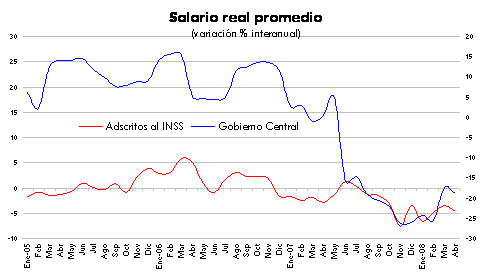
The law created the National Minimum Wage Commission which is made up of representatives of workers unions, the private sector and the Ministry of Labor (MITRAB). This commission is required to meet every six months to discuss appropriate adjustments to the minimum wage. During the twice yearly negotiations the Commission is instructed to take into account not just the cost of the canasta básica (see Note) and economic factors such as inflation and productivity, but also "the highest salaries paid by the state." The FSLN government's effort to bring public official's salaries down to the level of private formal sector salaries is demonstrated in the graph below.
In June 2007 FSLN deputies managed to push the new Minimum Wage Law (Law 625) through the National Assembly without permitting substantial modification by the opposition. This was a much needed piece of legislation which, in theory at least, sets the foundations for a regulated and functional procedure by which to establish the rate of the minimum wage. The "fundamental objective" of the law is to put into practice Article 82 of the Nicaraguan constitution which states that "workers have the right to a salary which permits a state of wellbeing compatible with human dignity."
The law created the National Minimum Wage Commission which is made up of representatives of workers unions, the private sector and the Ministry of Labor (MITRAB). This commission is required to meet every six months to discuss appropriate adjustments to the minimum wage. During the twice yearly negotiations the Commission is instructed to take into account not just the cost of the canasta básica (see Note) and economic factors such as inflation and productivity, but also "the highest salaries paid by the state." The FSLN government's effort to bring public official's salaries down to the level of private formal sector salaries is demonstrated in the graph below.
 Graphic
courtesy of Nicaraguan Central Bank Graphic
courtesy of Nicaraguan Central Bank
|
During
previous
governments the mega salaries earned by some of
Nicaragua's public officials had reached exorbitant levels. In a recent
interview with TcS, Treasury Minister Alberto Guevara asserted that
some top public officials in the previous Bolaños had been paid as much
as US$30,000 a month. Shortly after his return to power President
Daniel Ortega brought an end to government officials' mega salaries,
freeing up tens of thousands of dollars for social spending.
This move was part of the government's overall effort to reduce the gap between the rich elite and the impoverished majority as was the instruction to consider the "highest public sector salaries” during minimum wage negotiations. Perhaps the most important aspect of law 625 is the orientation for the National Minimum Wage Committee to "review and reform" the canasta básica "so as to provide 100% of the nutritional needs" of a family of six as established by the Institution of Nutrition of Central American and Panama (INCAP) and other institutions specializing in nutrition.
After two months of consultation and negotiations the Commission revised the canasta básica in August 2007, introducing substantial increases in both the quantity and the quality of food products, household goods, basic services and clothing included in the basket. As a result the cost of the canasta básica shot up from C$3,254.6 in August 2007 to C$7,217.3 in September 2007. This change was welcomed by unions. It provides them with a more convincing tool with which to demand significant pay rises for their workers. It also puts a certain amount of moral pressure on employers by transforming society's perception of a basic standard of living.
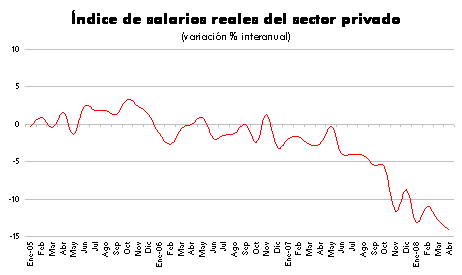
So far during Ortega's administration the average minimum wage has experienced a nominal increase of 33% (18% in 2007, 15% in January 2008). According to Roberto Gonzalez, leader of the Sandinista Workers' Central, this is the highest percentage increase to minimum wages since the 1980s. In real terms, however, the value of workers' salaries has fallen steadily since November 2005, as can be observed in the graph below.
This move was part of the government's overall effort to reduce the gap between the rich elite and the impoverished majority as was the instruction to consider the "highest public sector salaries” during minimum wage negotiations. Perhaps the most important aspect of law 625 is the orientation for the National Minimum Wage Committee to "review and reform" the canasta básica "so as to provide 100% of the nutritional needs" of a family of six as established by the Institution of Nutrition of Central American and Panama (INCAP) and other institutions specializing in nutrition.
After two months of consultation and negotiations the Commission revised the canasta básica in August 2007, introducing substantial increases in both the quantity and the quality of food products, household goods, basic services and clothing included in the basket. As a result the cost of the canasta básica shot up from C$3,254.6 in August 2007 to C$7,217.3 in September 2007. This change was welcomed by unions. It provides them with a more convincing tool with which to demand significant pay rises for their workers. It also puts a certain amount of moral pressure on employers by transforming society's perception of a basic standard of living.
So far during Ortega's administration the average minimum wage has experienced a nominal increase of 33% (18% in 2007, 15% in January 2008). According to Roberto Gonzalez, leader of the Sandinista Workers' Central, this is the highest percentage increase to minimum wages since the 1980s. In real terms, however, the value of workers' salaries has fallen steadily since November 2005, as can be observed in the graph below.
 graphic
courtesy of Nicaraguan Central Bank graphic
courtesy of Nicaraguan Central Bank
|
This
steady fall
is
due to inflation caused mainly by
external
factors, namely the devaluation of the US dollar and volatile oil
price rises. The FSLN government's efforts to keep down basic food
and public transport prices have reduced the impact of the
international financial crisis. These efforts, made possible by
Nicaragua's participation in ALBA (the Bolivarian Alternative for the
America's), put Nicaraguan workers in a better position than their
counterparts in other Central American countries.
The perception among the population that basic goods are more expensive than ever persists, however, despite food prices in Nicaragua being lower than those in the rest of the region, where salaries tend to be higher. So workers still feel the FSLN government is not doing enough to maintain or increase the value of their salaries. During the current round of minimum wage negotiations the majority of unions are calling for a 53% pay rise based on the logic that two working adults should together be able to cover 100% of the canasta básica.
The only differing union proposal is that of the Confederatión Sandinista de Trabajadores for a 25% pay rise alongside proposed agreements with the government for a housing project to benefit 10,000 free trade zone workers and increased coverage of the government's subsidized food programs. CST leader Roberto Gonzalez says "obviously" workers want their salaries to cover the cost of the canasta básica, but "it is very difficult to convince the private sector to allow for that."
The employers' organization the Consejo Superior de la Empresa Privada, the largest private sector association, proposes an average 11.29% average pay rise. COSEP's president Jose Aguerri explained that this proposal is based on the inflation registered during the first semester of the year (11.79%) plus economic growth (which was negative for some sectors). COSEP negotiators described the unions' 53% proposal as "totally unrealistic," warning that any increase above inflation plus economic growth would create widespread unemployment and stunt the national economy.
The Frente Nacional de Trabajadores representative Luis Barbosa, meanwhile, described COSEP's proposal as "not serious" and "irresponsible." He went on to challenge COSEP and other big business representatives to publicize their accounts with details of annual profits. COSEP negotiator Mario Zelaya said Barbosa's suggestion would not be considered arguing that a business' profits are a "private affair."
The Minimum Wage Commission will meet again on August 14 when Labor Minister Chavez is expected to present the government's proposal. According to MITRAB negotiator Ivan Acosta the government is aiming for a proposal which will "guarantee economic harmony," is "satisfactory for all sectors involved, does not provoke redundancies and is agreed upon between the government, workers unions and the private sector."
During both rounds of negotiations of the National Minimum Wage Commission last year, COSEP ended up abandoning the negotiating table arguing that the government did not take private sector proposals into account. On both occasions (in May 2007 and January 2008), however, the final percentage increase was almost exactly half way between the final proposals presented by both sides.
Private enterprise in Nicaragua is aware that it is only just beginning to feel the crunch of the US recession. Considering the increasingly adverse international financial context COSEP's previously expressed disappointment with the government's handling of minimum wage negotiations could well be converted into outright financial or political threats this time round.
Given the importance of the working relationship the FSLN government has enjoyed with COSEP and other private sector associations until now in terms of overall stability within the country, it seems unlikely that the government would feel able to approve a pay rise higher than the 18% registered at the beginning of the year.
On the other hand the government has to be seen to be sensitive to the desperate financial situation of Nicaraguan workers, who during the first four months of the year earned on average just C$2,266 a month, equivalent to a little over 20% of the canasta básica. The upcoming local elections are a further complicating factor in the negotiations which must produce an agreement by September 24.
Note
The canasta básica is a list of the price of 53 food products, household goods, basic services and clothing products in quantities required by a family of six to meet their basic needs. It also include rent. The canasta básica is used by public institutions, NGOs and other organizations as a point of reference.
The perception among the population that basic goods are more expensive than ever persists, however, despite food prices in Nicaragua being lower than those in the rest of the region, where salaries tend to be higher. So workers still feel the FSLN government is not doing enough to maintain or increase the value of their salaries. During the current round of minimum wage negotiations the majority of unions are calling for a 53% pay rise based on the logic that two working adults should together be able to cover 100% of the canasta básica.
The only differing union proposal is that of the Confederatión Sandinista de Trabajadores for a 25% pay rise alongside proposed agreements with the government for a housing project to benefit 10,000 free trade zone workers and increased coverage of the government's subsidized food programs. CST leader Roberto Gonzalez says "obviously" workers want their salaries to cover the cost of the canasta básica, but "it is very difficult to convince the private sector to allow for that."
The employers' organization the Consejo Superior de la Empresa Privada, the largest private sector association, proposes an average 11.29% average pay rise. COSEP's president Jose Aguerri explained that this proposal is based on the inflation registered during the first semester of the year (11.79%) plus economic growth (which was negative for some sectors). COSEP negotiators described the unions' 53% proposal as "totally unrealistic," warning that any increase above inflation plus economic growth would create widespread unemployment and stunt the national economy.
The Frente Nacional de Trabajadores representative Luis Barbosa, meanwhile, described COSEP's proposal as "not serious" and "irresponsible." He went on to challenge COSEP and other big business representatives to publicize their accounts with details of annual profits. COSEP negotiator Mario Zelaya said Barbosa's suggestion would not be considered arguing that a business' profits are a "private affair."
The Minimum Wage Commission will meet again on August 14 when Labor Minister Chavez is expected to present the government's proposal. According to MITRAB negotiator Ivan Acosta the government is aiming for a proposal which will "guarantee economic harmony," is "satisfactory for all sectors involved, does not provoke redundancies and is agreed upon between the government, workers unions and the private sector."
During both rounds of negotiations of the National Minimum Wage Commission last year, COSEP ended up abandoning the negotiating table arguing that the government did not take private sector proposals into account. On both occasions (in May 2007 and January 2008), however, the final percentage increase was almost exactly half way between the final proposals presented by both sides.
Private enterprise in Nicaragua is aware that it is only just beginning to feel the crunch of the US recession. Considering the increasingly adverse international financial context COSEP's previously expressed disappointment with the government's handling of minimum wage negotiations could well be converted into outright financial or political threats this time round.
Given the importance of the working relationship the FSLN government has enjoyed with COSEP and other private sector associations until now in terms of overall stability within the country, it seems unlikely that the government would feel able to approve a pay rise higher than the 18% registered at the beginning of the year.
On the other hand the government has to be seen to be sensitive to the desperate financial situation of Nicaraguan workers, who during the first four months of the year earned on average just C$2,266 a month, equivalent to a little over 20% of the canasta básica. The upcoming local elections are a further complicating factor in the negotiations which must produce an agreement by September 24.
Note
The canasta básica is a list of the price of 53 food products, household goods, basic services and clothing products in quantities required by a family of six to meet their basic needs. It also include rent. The canasta básica is used by public institutions, NGOs and other organizations as a point of reference.